The Birth of Music from the Spirit of Tragedy: On Rita Indiana & Mónica Ojeda
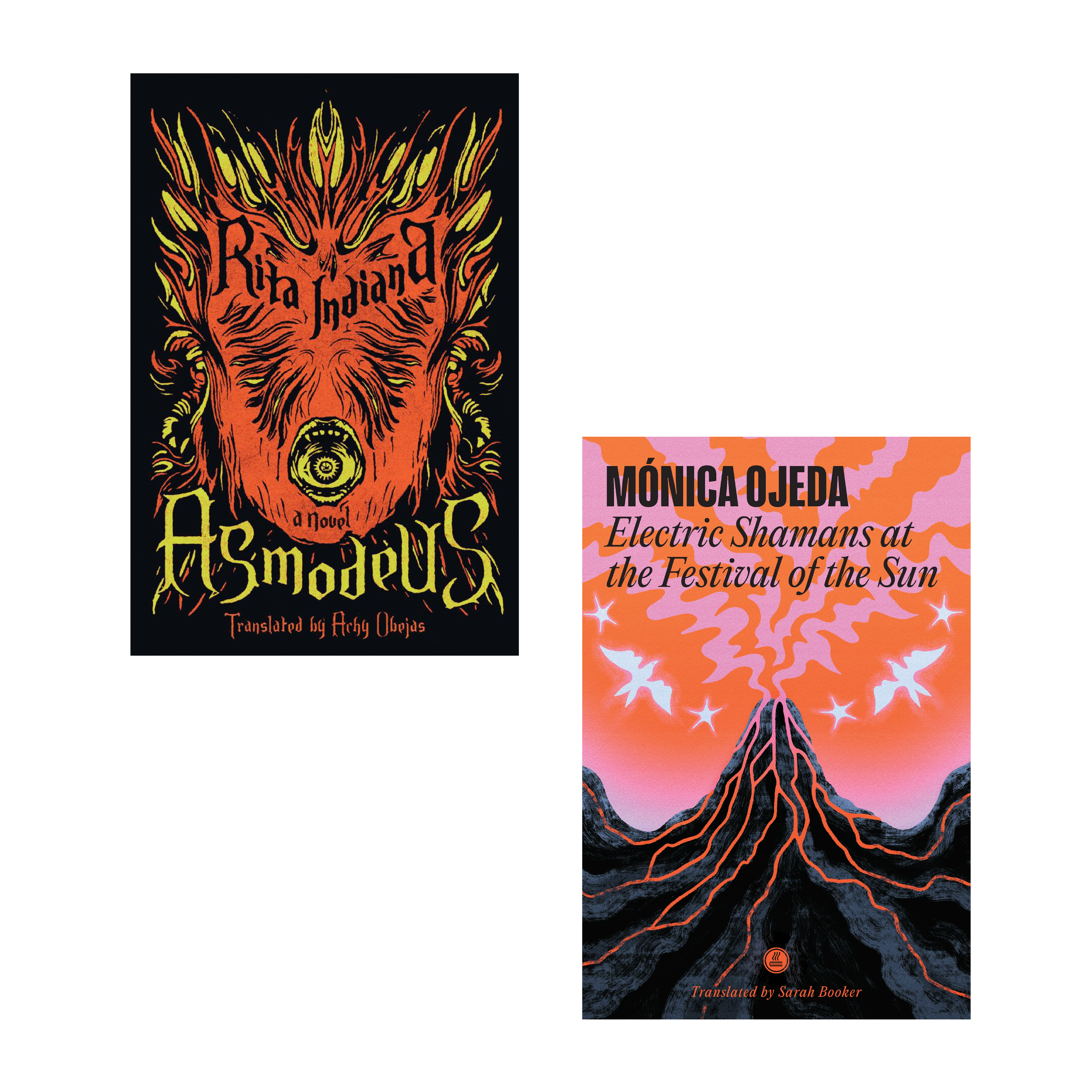
Rita Indiana, tr. Achy Obejas, Asmodeus. Gray Wolf Press, 2026. 224 Pages.
Mónica Ojeda, tr. Sarah Booker, Electric Shamans at the Festival of the Sun. Coffee House Press, 2026. 240 Pages.
Musician and novelist Rita Indiana’s 2020 album Mandinga Times, a witch’s brew of Afro-Caribbean rhythms, prog rock guitar lines, and electropop, has been described by the artist as a “songbook for the apocalypse.” Rita Indiana, known by her fans as her alter-ego “La Montra” or “The Monsteress” (in the Dominican Spanish dialect), continues her preoccupation with horror and possession in her fiction career. The album functions as a touchstone for her latest novel Asmodeus, translated into English by Achy Obejas, building on many of the themes and imagery she first established in the album’s sound and concept. Indiana embodied these themes of possession through the demoniac “nonbinary monster” alter-ego named “Mandinga” she created for the album. She meditates on the concept of possession through the song “El Zahir,” inspired by the Borges short story of the same name, a story also referenced in her novel Asmodeus. The narrator (self-identified as “what is left of Borges”) of the original story claims he is telling the reader about a coin possessed by an ancient entity referred to as “The Zahir,” which has previously possessed a tiger, a blind man, a fiber in a marble column, the bottom of a well. Across the ages,The Zahir drives all who beheld it in each form to an obsessive madness. In spite of Borges’s declaration of the coin as the object of his preoccupation, the story’s true focus is on the phenomenological experience of total obsession, the experience of being made to think and feel by an external entity, which also suggests the potential for meditative freedom through the object of one’s possession.
As interpreted by Rita Indiana on Mandinga Times, the coin is an avatar for capital and power, reflective of the corrupting influence any ounce of control tends to have on those who are in possession of it. The Dominican Republic has borne witness to this phenomenon over the course of the 20th century, which saw several iterations of dictatorship. 1930 marked the beginning of Rafael Trujillo’s long and bloody rule (assisted by a handful of puppet presidents). After Trujillo’s assassination in 1961, The Dominican Republic was briefly governed by its first democratically elected president, Juan Bosch, until he was ousted in a coup after about seven months in the role. The Dominican Civil War began when several factions conspired to launch a counter-coup. The US intervened by sending 42,000 troops to aid military forces in preventing Bosch’s reinstallment. Then, just five years after Trujillo’s assassination in 1961, the regime of Joaquín Balaguer began, one of many corrupt leaders backed by the US in its Cold War-era efforts to impede the spread of communist influence in Latin America. It is in the wake of Balaguer’s twelve years of authoritarian rule from 1966-1978, during which thousands of individuals in the political opposition were killed and tortured, where Rita Indiana sets her mischievous novel Asmodeus. The novel follows Rudy, a washed-up Dominican heavy metal rock star and Balaguer-era torture victim, as he and Asmodeus, the ancient demon who inhabits his body, attempt to reclaim their former glory by writing the great Caribbean rock opera. In doing so, the two unwittingly foretell the fates of kids in Santo Domingo’s early 90s thrash metal scene in the Baroque Spanish décima form.
The demon Asmodeus shares mutual mechanics with the Zahir of Borges’s story in that as eons pass, each spirit finds more and more lowly hosts, and yet, as in the traumas inflicted upon the New World through braided histories of exploitation, the spirit persists. Where Borges provides a perspective of a man possessed by obsessive thinking, in Asmodeus, Rita Indiana’s focus is on the possessor more than the possessed, who in the novel are generally unaware they are under the control of an external force. Although Asmodeus possesses Rudy through whispers and memories, the musician is generally preoccupied with his personal ghosts and labors, and it is the demon himself who tends to demonstrate the most external sonic awareness in the text. “A certain clumsiness in the flamenco-inflected keyboard jumped out at Asmodeus; the strings hummed elementarily, the keyboard hissed a summary, the song was a poorly constructed memory,” Rita Indiana writes in a chapter where the narrative decomposes, along with Asmodeus, into fleshy hallucinations. I personally found Asmodeus, along with the eponymous demon which inhabits it, to be at its strongest when it was most hallucinatory, on the precipice of death and rebirth, sublimated into (dis)embodied precognitive poetics, as in Asmodeus’s transfiguration: “He fixed his sight on a small pool of pus where a bat’s ear grew, just like a bromeliad. Through it, he heard other voices, lamentations drowned out by his own screams.”
The novel cites a host of references to early heavy metal and early 90s thrash metal albums amidst a landscape of merengue, but given Rita Indiana’s background as a songwriter, it is more attentive to the processes of composition. Indiana interrogates what it means to engage in the composition of literature and music rather than exploring the relationship between sound and music to the listener. The performance of music is framed as a form of transfiguration, as when filthy rich kid Claudio plays Black Sabbath’s “The Sign of the Southern Cross”, a spectacle in which “the singing expanded his body and flattened everyone else’s,” his face “transfigured” in the thick of a “fusing pelvis and guitar”. The writing process itself is framed as a collaboration with a demonic voice, a form of necromancy, an “art of moving ghosts” with the mind, “ghosts from the future, extracting translucent copies of the living.” Rita Indiana takes a Borgesian turn to the metaphysical, echoing the dreaming of life into existence as portrayed in Borges’s story “Circular Ruins.” The writing of Rudy’s rock opera first seems to demonstrate a form of remote intelligence about the lives of his living subjects, then premonition or determinism as to their fates, the text-within-the-text interweaving with the outer text until the literary act within is indistinguishable from living itself.
As Rudy produces his stream of décimas, he occupies the role of executioner, exercising judgment upon his puppets, determining which character will become the sacrificial lamb to render his work tragic. Indiana writes Rudy as self-reflective about his own economic privilege as he composes his class tragedy, filtering much of the book’s class critiques through the perspective of an upper-middle-class writer’s process. He is aware that it would be more comfortable to write a work of justice, where the rich who feast on the spoils of dictatorships and racialized class structures would be made to pay for how they have benefitted from exploitation. The work he produces adheres to the plot conventions of tragic form, but as a whole, Asmodeus is much more ambiguous, concluding on a frustratingly optimistic beat. In a comedic approach to the processing of trauma, the tortured confront the torturer and, in order to move forward, release the burden of resentment and choose forgiveness. Yet the angelic realm weeps for the injustice of this restorative approach. To those who desire moral balance, forgiveness is, by nature, unjust.
//
Rita Indiana’s Asmodeus is primarily oriented toward the perspective of the demonic possessor and the production of musical and literary work. On the other hand, Mónica Ojeda’s Electric Shamans at the Festival of the Sun, another Spanish language work from 2024 which has also received its English language translation in 2026, centers the listener in a framework of spiritual possession. In fact, Electric Shamans is in direct dialogue with Rita Indiana——her song “Miedo” (“Fear”) from Mandinga Times being the first of several musical references within the novel. Set in memories of the near future at a music festival at the foot of Ecuadorian volcano Tayta Chimborazo——the closest point on the planet to the sun——the novel is a chimera. Part sonic philosophy manifesto, part primer to Ecuadorian folk traditions, part lyric poem, and part fiction told through the outgrown codependent friendship of Noa and Nicole. These characters are bonded by troubled relationships with their fathers who flee unabating narcoviolence in the Ecuadorian coastal city of Guayaquil to attend Solar Noise. Psychedelic ecstasies are interrupted by the sober journal entries of Noa’s estranged father, who has retreated from the violence in Guayaquil, abandoning his family for a hermit life in the volcanic foothills. Interspersed with Kichwa language incantations and uninterpreted regionalisms, Electric Shamans is a love letter to Ecuador——especially its myth and music——written from Ojeda’s own exile state in Spain where she herself relocated to escape escalating violence in Guayaquil.
Until fairly recently, Ecuador held a relatively peaceful reputation, mainly known for its ecotourism industry, volcanic eruptions, and earthquakes. In 2016, neighboring Colombia entered into a historic peace agreement between the Colombian government and far-left paramilitary group FARC, then in top-down control of cocaine trafficking operations between Colombia and Ecuador. FARC disarmed and dissident factions of former FARC members reincarnated into their own drug gangs, and the Colombian government gained more control over its transportation hubs. The dissolution of FARC created a power vacuum for cartel activity in Ecuador as trafficking shifted toward the shipping industry in Guayaquil, where homicide rates have increased dramatically, and corruption has rampantly infected the heavily expanded police and military, who have been accused of human rights abuses. At least since March of 2026, the US has been confirmed to be involved in the conflict, launching a joint attack alongside Ecuadorian troops against FARC dissidents along the Ecuadorian border with Colombia, Recent evidence, however, has emerged indicating covert CIA involvement in aerial attacks of Ecuadorian boats as early as January of 2026 (not long after the US bombed northern Venezuela and abducted Venezuelan president Nicolás Maduro on drug trafficking charges). The region is volatile geopolitically, as well tectonically: in 2026, the North Andes tectonic plate was hit with devastating earthquakes, resulting in extensive damage and significant death tolls in Venezuela and Colombia.
Ojeda’s work has been identified in recent years with an emergent Andean gothic movement within contemporary Latin American fiction. Where the Southern gothic movement of 20th century US South was characterized by religious fervor, poverty which follows extractive economies, and ghosts of a place scarred by lingering racial injustice from its history of slavery, the Andean gothic draws from a surrealist well in the depiction of hostile landscapes and an ecosystem of violence which subsumes all within it. For example, Carson McCullers and Flannery O’Connor’s instances of spiritual isolation and fraudulent street preachers in such texts as The Heart Is a Lonely Hunter and Wise Blood, which communicate the horrors of the past subtextually. By contrast, the Andean gothic, as rendered by Colombian author Evelio Rosero in his novella Way Far Away, is much more overt, depicting the violence of its context as one where people cannot look at each other for fear of implicating themselves, the crunch of death underfoot with every step. Electric Shamans presents varied responses to the problem of how to live with oneself within an ecosystem of violence. The novel challenges the proposition that it is even possible: in order to find oneself decent in a system which drags people into complicity, the only viable option is escapist neglect.
The text frames withdrawal from a violent world and into silence as an attempt to separate life from death. Music, however, is a site of integration with the brutality and complexity of being alive. At the festival, Noa and Nicole meet Pamela, a podcaster who is the novel’s primary instrument of sonic philosophy. “Arousal as resistance to death,” Pamela defines it: music as a phenomenon which originates in death and simultaneously resists it by means of arousal, which is also based in death. “Music is what makes us feel like there’s something worthwhile in the pain: the pleasure of tomorrow, the pleasure made possible by absence,” she assures. Nicole, however, resists what promises music might offer to the redemption of life’s suffering, “And of course it isn’t enough: Men and women kill and die, children kill and die, the earth bellows in a rage, and the music dreams a measly dream that feeds on what little we have left.”
Others learn to dance in the duality of violence and vitality, like Mario, who dons the costume of Aya Uma, the two-faced ceremonial spirit guiding the Inti Raymi solstice festival through dance. “I’d say a nightmare is dark, but it illuminates the dance of the mind. It creates bedeviled dances that make us love life,” Mario says. He prefers to refer to the Aya Uma by the name Diabluma, given by the Spanish, who assigned significations of the Christian devil to Aya Uma. As if to say, the newly fractured notion of good vs. evil offered a new potential to identify parts of oneself in the concept of evil. The historic association of indigeneity with the demonic has been recorded in the paintings which emerged out of the colonial epoch. A Portuguese painting called Hell from the early 16th century, held at the National Museum of Ancient Art in Lisbon, depicts Satan wearing ceremonial garments of South America while presiding over demons ushering souls into a burning cauldron. An Apollonian moralist structure centered on idealism comes to destabilize formerly integrated aspects of human nature. Yet when the duality of light and darkness is both acknowledged and embraced, therein lies the ecstatic. This is the hope that many of Ojeda’s characters place in music.
//
In contrast with colonial-era visual art’s framing of indigeneity as demonic——a vessel for the colonial epoch’s Apollonian moralism which persists in literature——the Baroque exerts a force of demonic influence on Latin American letters. Much of Latin American literature has been historically evaluated against its relationship to the Spanish Baroque literary stylings of the period of the New World’s colonization, as exemplified by Luís de Góngora and Miguel de Cervantes. Borges and Cortázar explicitly rejected the flourishes of the Baroque. Father of Latin American modernism, Nicaraguan poet Rubén Darío notably explored repurposing Baroque language, as did Cuban writer José Lezama Lima by decoupaging Spanish Baroque, African, and indigenous techniques into a new ornate amalgam. In 2666, Roberto Bolaño invoked the Baroque through his complex web of interconnected characters and fragmentation into pure symbol akin to the Book of Revelations. The literary scholar Andrea Carretero Sanguino describes Ojeda’s previous output as “cold baroque”——a term first attributed to Francisca Noguerol’s work——referring to a literary technique that reflects the fractured identities and grasps on reality of the internet age.
Rita Indiana is particularly explicit in her references to the Baroque. Asmodeus presents scenes of Rudy fueling his creative vision with Vivaldi, calling to mind the influence of Bach and Vivaldi’s fast tempos, counterpoint, and complex arrangements on the prog rock which birthed heavy metal. Achy Obejas has valiantly risen to the challenge of translating décimas, retaining the rhyme scheme of the form whose flame Latin America has kept alive since the 16th century “Golden Age” of Spanish literature, a form also used by such artists as songwriter Violeta Parra, who used the décima to sing about political injustice, integrating it with Chilean folklore. In a similar vein, Asmodeus enacts the haunting of history, conveyed through its plot centered on the repetitive reconstitution of the demonic, and its consideration of colonial-era forms which have persisted alongside generations of trauma and economic injustice. “Power is like a horror movie,” Rita Indiana said in an interview given to Pitchfork for the release of Mandinga Times. “It’s like a house that people enter, where there are dead bodies, and the dead possess them. And they transform them into the shit that was there before.” History, of course, doesn’t repeat; it rhymes.
In a 2023 lecture entitled “Cabezas de chamana y las escrituras del éxtasis” (“Shaman Heads and Ecstatic Writing”), Ojeda sets forth a framework for monstrous literature——not simply monstrous in topic, but in form, uncategorizable mutant literatures are those by which many New World amalgams of literary form can be identified. This framework may also be applied to the mixture of cultural forms Indiana incorporates into her musical projects, or to Brazilian tropicalia’s composites of Brazilian popular folk music and Western rock. In Electric Shamans, Ojeda similarly provides a number of speculative chimera genres integrating South American roots with Western modalities, such as “ancestral thrash retrofuturism”, “experimental shamanic noise”, “electropasillos, rumba blues, mambojazz, bachatapop, and capischafunk”.
Chimeras of form are one pathway to project from the ancient into the future. Through the use of chimera motifs and breaking from sequential narrative, Ojeda explores non-linear temporal forms inspired by indigenous Andean conceptions of time. Museo Anahuacalli in Mexico City, for example, which houses Diego Rivera’s collection of blocky pre-Hispanic figures in a modernist building constructed from on-site ancient volcanic materials, seems to exist eternally outside time. Within the museum, there is an ongoing exhibit of works by ceramic artist Lorena Ancona, “Ojos como pozos, boca como cueva” (“Eyes like wells, mouth like a cave”), fleshy extraterrestrial quasi-forms of celestial (re)birth are situated among Rivera’s sketches for murals depicting Apollonian scientific endeavors against scenes of agrarian labor uprisings.
In the lecture, Ojeda goes on to frame horror as that which is characterized by both desire and repulsion, a dialectical structure echoing Pamela’s theory of music in Electric Shamans as a perpetual engine of arousal and death, a monster which cannot be satisfied. Hell is the music of the spheres, a symphony in a state of continual transfiguration. Ever caught in the motif of its own death, in a great collective trance. Ever slaughtering, ever embracing. “The party forms around what we’ve lost and will lose,” Ojeda writes. “The bad thing is that nothing ever really comes back and what’s lost never returns, only its ghost does, but the music asks for sacrifice and a resurrection, it demands that life go on after death and assures us that the ability to kill is nothing next to the power to conjure.” On we go, dancing into the night.