Toward Love in an Age of Annihilation: On Fady Joudah’s /Exhibit G/
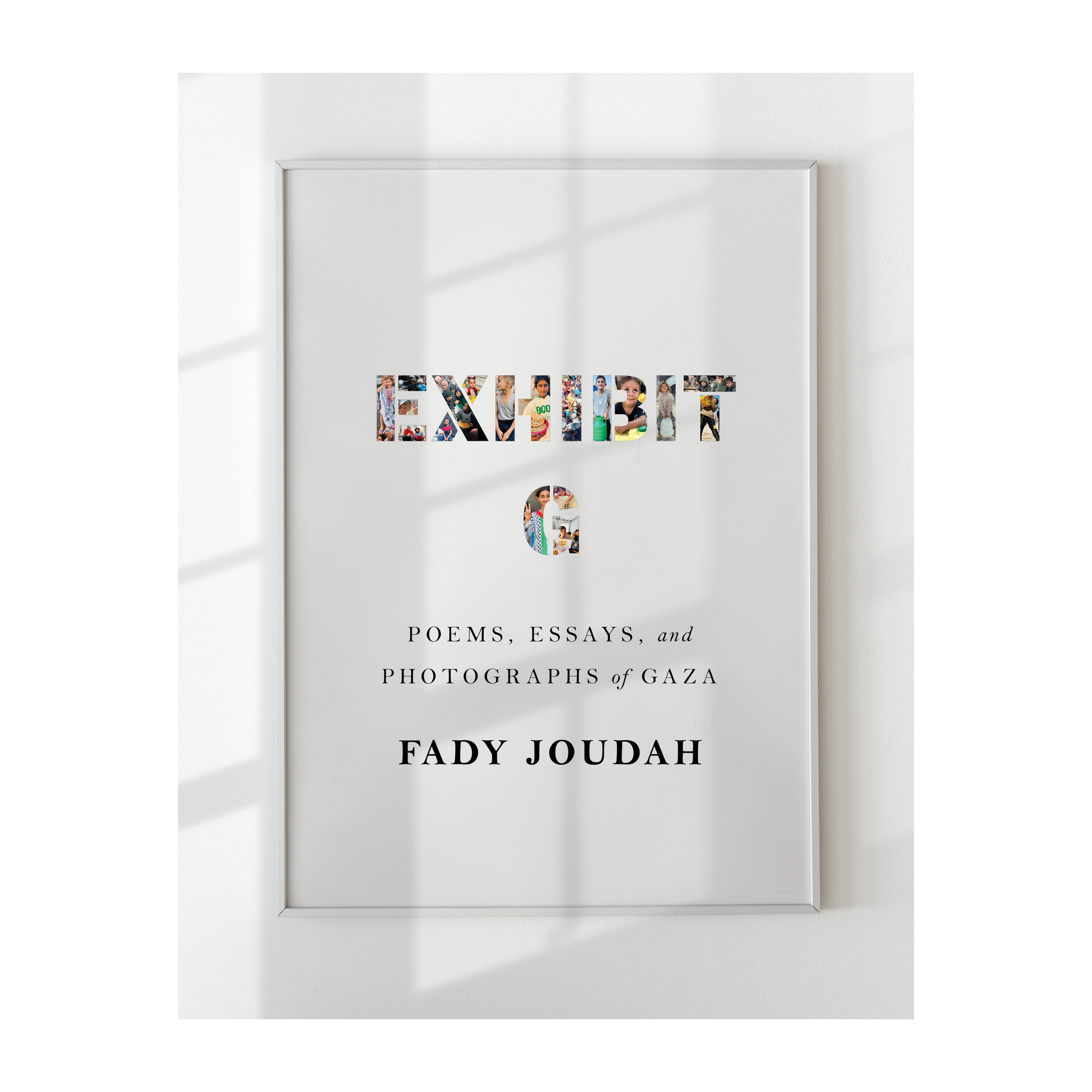
Fady Joudah, Exhibit G. Milkweed Editions, 2026. 208 Pages.
A few months before reading Fady Joudah’s Exhibit G, I was walking from Portugal to Spain on the Camino de Santiago. It had been more of an impulse decision than a cross-country walk should be, but I needled on in my insistence I would complete the route. When my family tried to dissuade me (“you get winded walking up a flight of stairs”), I leveled back what I felt was a finalizing argument: “It’s a pilgrimage.” I had long been interested in acts of spiritual endurance and I somewhat naively thought there was something protective in electing for suffering as a symptom of devotion. An oft-used Camino greeting is “suffer well.”
Along the route, I started listening obsessively to a song my father used to sing when I was young and it had a strangely catalyzing quality to it, urging me on.
In “Ahwak,” Abdel Halim Hafez sings: "I love you. And I wish that if I ever forget you, I [also] forget my soul with you.”
“So dramatic,” I used to tease my father, who was genuinely wounded by this accusation. "What is more important,” he would insist, “than remembering? This is proof of love.”
Exhibit G is a book built on hybridity in form, on polyvocality, on a shifting catalog of loss. But what struck me most was the way love emerges as the reason for Joudah’s record. “And a world we want to begin begins,” Joudah writes in the first poem of the collection. “I turned my love for you into art, // that I may triumph over death.” The first gesture of the book is involved in transformation, in creation. In resisting annihilation by insisting on a love so immense it catalyzes immortality.
Not unlike a pilgrimage, there is a sense of searching in Exhibit G. We search through different periods of bombardment. We search for different Gazans enduring beyond belief. We even search for Joudah in the diaspora, reckoning with the simultaneity of distance from and proximity to an age of annihilation. And we enact a search through Joudah’s countless questions, which feel deliberately unanswerable:
“What if Palestinians love their freedom more / than you love their unfreedom?” (“Inimitable, I Repeat”).
“Where else in the US today is a shared living space capable of organized resistance?” (“Exhibit G: Baby Moses & Khalas or Notes on Palestinian Interiority”).
“What is enough childhood for a people to stay alive? What image of childhood is enough for a people to stay alive?” (“Exhibit G: Surviving Image”).
There is something profoundly ritualistic in the way Joudah attends to scale so that smallness is impossible. Yellow dates, baby Moses, “a long fragment of a blown corrugated fence.” Each of these fixtures are imbued with literal and symbolic meaning. They bear the traces of violence but they also bear the traces of endurance. Joudah attends to each image with such devotion that the work feels almost spiritual.
This is rarely a project that Joudah takes on alone. Exhibit G cannot be considered apart from its collaborative impulses. Joudah notes combing through countless images sent to him by the Gaza Soup Kitchen. He includes cartoons from Naji Al-Ali, a painting from Abdul Hay Mosallam, and translations of texts by Gazan writers Rawan Hussien and Nima Hasan. In one of Hasan’s poems, “Poem #4 of 5,” we get
Don’t go alone to your sadness.
Take me along as an idea,
a witness,
or evidence,
and with two open arms,
an embrace,
shut the wound’s door.
They even killed
the names of lovers.
No walls, no trees
remain to confirm
that love ever
took place here.
I thought again, while reading this, of the Ahwak lyric in that forgetting is as much a violence to the self as it is to the forgotten. You lose your grip on your soul if you lose your grip on the souls of others. To go alone is to surrender to the colonial desire to isolate and, thus, justify the narrative of imperial expansion. But Exhibit G is a refusal of aloneness. Just as Palestine has never been an empty, uninhabited land, the memory of Palestinians will never empty either. To remember together is to outlast the attempt to erase or revise history.
One of the tangled complications Joudah faces is what one does when the tools we use to record each other's histories are very often shaped by the same forces pursuing erasure. And so: language. Language is violence. Language is a colonial extension of empire. But language is also involved in documentation and, by extension, preservation. It’s a conundrum Caribbean-Canadian writer M. NourbeSe Philip confronts in “The Absence of Writing or How I Almost Became a Spy.” Philip argues that writers and colonized people are often forced to “occupy the master’s house,” to use his language and turn the weapon of English against itself. There are shades of this logic in Exhibit G.
Joudah refuses to give empire sole custody of language or of image. He builds a lyric and visual vocabulary of his own, and he presses against words that have been worn smooth through overuse: witness, archive, conflict, evidence. Each comes with unavoidable questions: what are the limitations of witness? Who does an archive exclude? How does ‘conflict’ feed denialism? How does evidence require the oppressed to audition for empathy?
“This onslaught on my being,” Joudah writes in “Exhibit G: Baby Moses & Khalas or Notes on Palestinian Interiority,” continuing “By claiming what is being actively erased, I become presence. In this presence, the border zone between Arabic and English is fluid. Imperial reach leans into brackish water to exert control, but also the Palestinian question resists the logic of boundaries in the age of the nation-state.” To claim what is being erased is to insist on being present in a language that would rather speak about Palestinians than with them. And Joudah refuses the role of prophet. “I am not a visionary,” he writes. “I am not ahead of my time. I am Palestinian in a world blind to its time.” The failure isn’t one of foresight but of sight. The world has looked and then chosen to look away.
So, Joudah continuously refocuses his lens. Part of this involves revising the terminology of catastrophe throughout Exhibit G. Palestine undergoes, at once, a genocide, an annihilation, an “incremental repetition of the Nakba.” There is a similar multiplicity in the titular G. It is G for Gaza, G for genocide, G for gone, G for guilt, even G for God. In this way, the instability of language is its own character in Joudah’s study. The ultimate shapeshifter, impossible to trust but also impossible to abandon.
“The next day, another bomb in your neighborhood one or two streets over,” Joudah writes in, “Exhibit G: Toward It, Not Away From It.” He goes on, “You run toward it, not away from it. This signals a distinction in your condition from your killer’s...You're trapped under the debris of this language. No manual to help you navigate the extermination of your people.” To run toward, in this moment, is an act of humanity. The debris that falls here——language——is the exact thing we wade through as readers and the exact thing we take part in weaponizing.
It would be reductive to think of Exhibit G as a kind of manual through this. But it does emerge as a text that is at once lyric and forensic in its call to look toward, to run toward, to witness toward. There isn’t so much an argument that doing so will resuscitate, will offer solutions, will unbury kin from rubble. And this is one of Joudah’s most powerful touches: he is not here to comfort readers. He is not here to explain. He is not here to plead, or to perform grief for an audience.
Instead, Exhibit G feels like an immensely tender act of holding. We can see this in Joudah’s use of brackets and ellipses——a visual reinforcement of absence, of silence (forced and chosen), of a drastic emptying of space and history ignored. We can see it in the very etymology of ‘exhibit’ as a word——from the Latin exhibere, ex- ‘out’ + habere ‘hold’. We can see this in ekphrastic poem-essays narrating the lives of a medic in “Wallah” (“How will his body let go if he lives to old age?” Joudah asks) of a pregnant woman in “Salaam Ya Salaam,” who has survived as the “last of an annihilated family line,” outliving her murdered mother, father, and three younger siblings. And we can see it in the use of photographs, so many of which feature Palestinians carrying something. They carry water jugs, wagons filled with the last fixtures of destroyed homes, makeshift toys, pots and plates that are ominously empty and pots and plates that are miraculously full. They carry each other. They carry stethoscopes, they carry kittens, they carry cameras, they carry histories of displacement and histories of rebuilding. To carry is to care. And to embrace a logic of “toward” is to embrace a logic of transcendence, not over suffering, but in the plainest sense: to move toward something is to move beyond something else.
But moving toward also means looking toward. It’s here that the photographs of Exhibit G do more work than they first appear to. And so: image. If language can be a complicated and bidirectional weapon, so can the image. Image is violence. Image is spectacle. Joudah knows how the world consumes Palestinian suffering: “The world that produces horror circulates its horror in images,” he writes in “Exhibit G: Surviving Image,” continuing, “In a world addicted to the propaganda of spectacle, only the spectacular crime can make the Palestinian visible.” We know the images this world prefers: rubble, smoke, bodies under sheets. Joudah’s curation refuses this. Yes, there are images of grief. But there are images of community. Mothers hold their children. The Gazan men whom even advocates seem to leave out of their appeals, as if their deaths are somehow expected, are shown standing in line for food, cutting each other’s hair. Joudah doesn’t deny the camera’s capacity for violence; he takes the camera back. The image here is not a plea for recognition. It is an assertion of one piece of Palestinian life on Palestinian terms.
This is where the book’s hope lives: not as relief from grief, but in memorializing the ways people go on living alongside it. In “Symphony in G Major,” Joudah writes, “the doctor in me says, Whoever is without hope, cast the first stone. Hope, a cellular thing, coded for, translated. We couldn’t keep it out if we tried. And if hope wanted out, no one could keep it in.” For Palestinians under occupation who have experienced how much undermining freedom involves undermining movement, the language of uncontainability that Joudah gives to hope offers it up as one of the ultimate counters to imperial force. Hope is not optimism. Hope is impossible to conquer.
When I was first reading Exhibit G, my father stole my copy of it. I found him sitting in his garden, next to what used to be a bed of mulukhiyeh he grew using seeds his uncle in Palestine sent him years ago. He was flipping through the pages of Exhibit G with boyish wonder. Not wonder because it was a book without grief. But wonder because recognition felt, for a moment, like a miracle. Just like that: an image of mulukhiyeh. Just like that: an image of a boy who looks, he said, just like my uncle as a boy. “He’s writing about khubaizeh,” he told me giddily. “This is something that cannot ever be stolen because unless you are Palestinian you will not know it.” I’ve always envied hope that emerges like this. That when so much has been stolen, you still find the will to believe anything is safe. The capacity to invest in culture, in community, in love, unconditionally——even when the world offers nothing back. In my father, I saw the way Exhibit G is filled not just with collective grief. But with the collective. The amongness it enacts and shares is its truly revolutionary act.
And if hope is cellular in Exhibit G, so is love. In “Exhibit G: Baby Moses & Khalas or Notes on Palestinian Interiority,” a Palestinian friend tells Joudah they have wasted many beautiful years believing in America. “You have wasted nothing,” he answers. “You believed in love, in common decency. Inferiority was not why you let yourself love. Transaction was not why you loved. It is not your fault that your love was not the love this place could love you with.” Earlier in the book, in “From Dear […],” Joudah laments: “I have my dead, and I am changed / because you have wasted their lives.” Here, to see Joudah’s speaker insisting: “you have wasted nothing,” feels like a moment of reclamation. Love is a worthwhile endeavor and the most human work to do.
When I finished my pilgrimage, walking over 170 kilometers to what I thought would be some kind of spiritual revelation, I felt more or less the same. But then, emptying into the Praza do Obradoiro, I was shocked to see a massive Palestinian flag, upwards of 100 feet long, draped across the facade of the Pazo de Raxoi. That evening, two hours after the pilgrim’s mass, a Palestine rally was scheduled in the square. The flag was waiting for them. Across from a 1200-year-old cathedral, next to a $500-a-night hotel, surrounded by hundreds of pilgrims and hundreds of tourists.
The diasporic encounter of a symbol of homeland has never failed to feel, to me, like a miracle. But lately, I’ve also been thinking of it as evidence. Not just evidence of hope, of possibility. But, yes, of the capacity to endure. In many ways, Exhibit G feels like a similar kind of miracle. Faithful. Surprising. Comforting. Disquieting. Something some might call proof of life. Something my father might call proof of love. The refusal to let something disappear.
In Spain, that flag was still hanging when I left in the morning.
***
Notes
The phrase “audition for empathy” comes from Hala Alyan’s 2023 op-ed article for The New York Times “The Palestinian Double Standard.”