A Mother is a Sequin: On Laura Kolbe’s /The Decadent Movement/
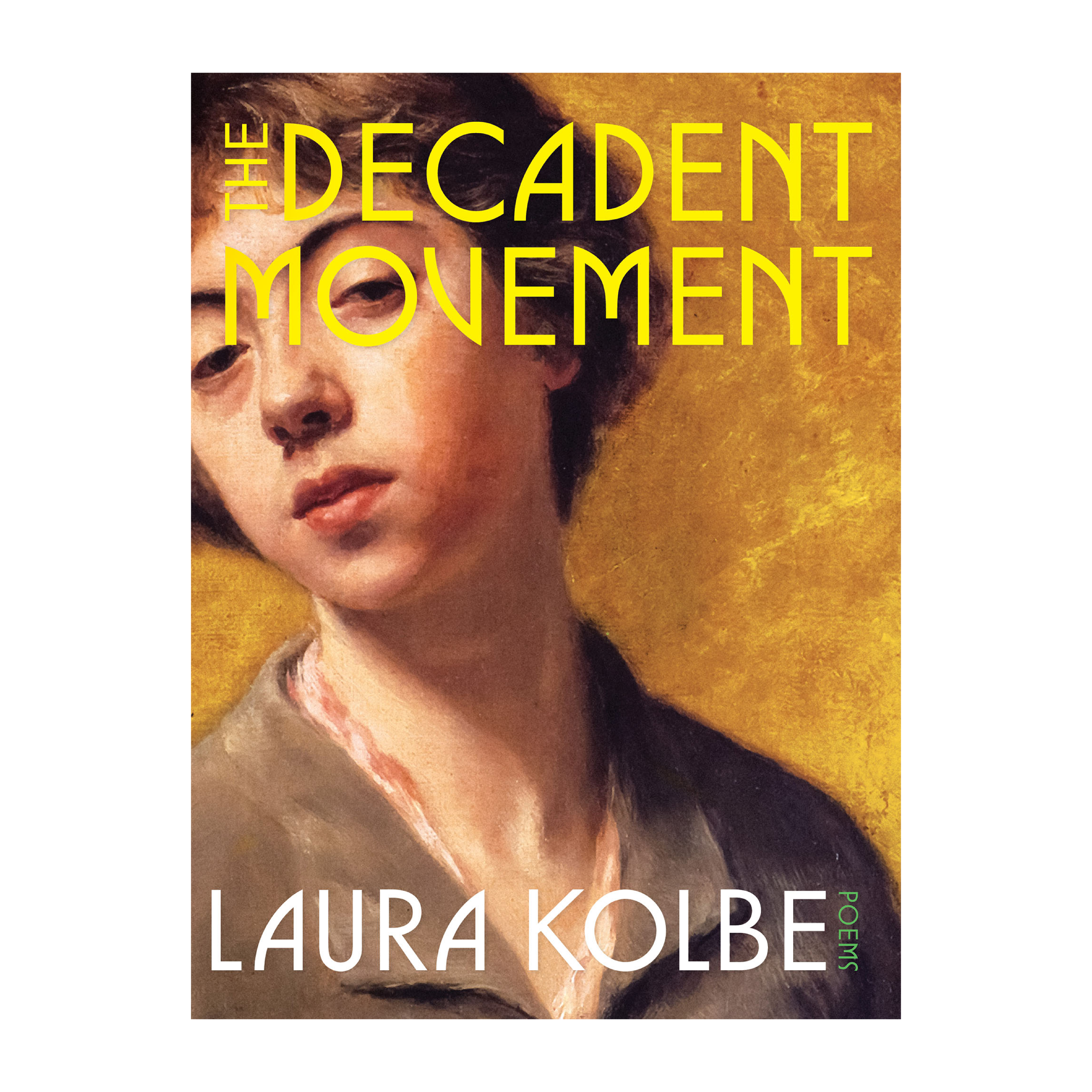
Laura Kolbe, The Decadent Movement. University of Pittsburgh Press, 2026. 128 Pages.
Threes by turns propel, unsettle, and comfort the forms of Laura Kolbe’s The Decadent Movement. Recursive tercets constitute the heartbeat of her second book of poems, which undulate forward with careful sonic and rhetorical emphasis. She writes, “I wear everything that’s happened to me / And some things that haven’t but expropriate / Beautifully in accordion pleats. Dress-up’s a sport.” Kolbe’s tercets delight in transformation as the speaker herself whirls through multiple states of entanglement, including motherhood.
In one of my favorite poetry craft books, A Little Book on Form (2018), Robert Hass says of formal trinity that “mystery begins here,” so too that “there is something of imbalance and excess in threes,” “too-much, overflow, play.” This sense of threeness occurs both formally and thematically in Kolbe’s poems as they revel in interdependence and playfulness. Her language weaves through formation of care-based relationships beyond gendered tropes of sacrifice and docility associated with motherhood. “I lived this stage as solid,” Kolbe writes, “a boolean of dust. Knowing it’s more common / to be liquefied in flow. To pluralize, to them myself in others.” In her poems, she drafts care that does not dissolve the mother’s self in a child or marriage.
Though the speaker resists unmaking, she is sinuous, moving like light on glitter: “My needle through the eye // Of the sequin of me.” The Decadent Movement engages the labor of mothering——writing is compared to nursing, both cause “the body / to widen and deepen its reserves, to beef up to / the point of pain.” But Kolbe also delights in the play and power of iterative transformation: “To mother is a power ever to be / repeating.” Motherhood, frequently seen as a moment when doors close, is figured as a capacious state where care opens and transforms. A mother is a power, not a script that flattens under terrible legibility.
Motherhood can be associated with dependent, two-part units: mother and child, mother and other parent, the mother’s body sacrificed to create a new family. But Kolbe, through both statement and form, refuses the collapse of a mother into another body. Her fluid syntax renders the speaker’s relationships with dimension. If three is where mystery enters, three is also where care that does not collapse dignity into basic relational roles begins. In another tercet: “I will not live / like the chipper clump of October hydrangea. / Empty at the center.” Some of my teachers and peers have taught me to think about the couplet as the ultimate container for a relationship: the two lines carry the charge and proximity (or lack thereof) between a person and their beloved. Not only in an amorous sense, but any kinship. The two-part stanza becomes a vessel for a connection’s dynamics, setting up poles between which intimacy bounces. By this logic, a couplet could plausibly constitute a foundational unit in The Decadent Movement as a text concerned with the growth of a relationship between mother and child as both parties themselves change. But Kolbe’s poems overflow the coupleted “me and baby” logic. While couplets weave through the book, her stanzas mostly disengage from two-part arguments. The tripartite structure consistently complicates rapport. Two tercets early on:
Thread while we sleep, to the floor, the air—
Everything winds up everywhere, that’s thermodynamics,
That’s a family reaping its subsistent furrow
While another family gleans behind it.
At dawn S. will stand in his crib like a farmer
At the plough, egging on the next turn
In the second tercet, Kolbe portrays the child in his crib with a lush simile that adds intellectual and implied physical motion to a figure standing still: poetic thrill! In a couplet composed of only the last two lines, the fullness of the speaker’s attention would rest on the child, narrowing the stanza to the relationship between mother and baby. But the addition of the first line makes three. The continuation of the previous stanza’s doubled family image and thermodynamic muchness expands the intellectual and emotional space in the tercet, creating room for both mother and baby to exist in worlds beyond only their relationship.
In a case where twos do appear, the coupleted poem “Simple,” the speaker’s capaciousness is compressed to a function. Kolbe writes: “My feet demurely / callused because I will work and work. // I may as well have had just one organ, / so simple am I, one tube like a sea sponge.” Socially, a mother is often perceived as entirely accessible through reduction and transparency. Kolbe addresses this perception as she continues: “There is nothing // scary, amiss, or unrelatable about me, / who am comme il faut. You’d think // I was a plant, you’d think no problem!” A person is reduced to the function of motherhood; observers assume this limited projection is all there is to know, such that a mother is totally legible as an interlocuter.
Kolbe structures her language against that assumption of access. In “Against Maternity,” Kolbe writes “Do not hollow me.” She dodges hollowing by actively engaging the awkwardness of dependency. Early on, Kolbe figures intimacy’s discomforts with humor as she describes the speaker and a balloon tied to her wrist:
I usher spoon to my mouth
to feed myself—the baggy ball
imposes on my nose…
my kingdom
for a house without confusion!
—orient and corporate
our beings being
air in some part and in others
matter of a thicker, duller
kind
The disorientation of being can be joyous. It can also look like a loss of selfhood as a mother is digested in the social body. Kolbe articulates both experiences. “I knew I’d see my insides on your outsides, / how you’ve been smeared and tossed,” she writes.
Even before pregnancy, the speaker was keenly aware of cultural scripts regarding her body and social position. In “Still,” the pre-pregnancy speaker is “a mean sibyl and a sleepy drunk, rocking on the sunup / subway.” But also, in “Street Cleaning Day,” she is “what’s known / as a good girl, completing the exercises,” oscillating between the Madonna and whore roles so often imposed upon young women. As Kolbe engages feminine caricatures——flimsy cutouts of girl, mother, lover never meant to hold human complexity——the formal logics of syntax and stanza become tools to skirt solid states. She leans into play. The speaker wants the “warfarined mouse on the rug / to be sleeping only,” transfiguring a brand of pest killer into a verb. Kolbe delights in such linguistic mutation, and her sumptuous syntax is punctuated by moments of humor: “I see myself now in those forgotten unbeloved / presidents of the nineteenth century / gaunt even when they were fat.” When faced with tropes that seek to dictate her horizons of possibility, she chooses to tease and transform.
In a poem two-thirds of the way through the book, “2003 Snapshot Found in the Nightstand at My Parents’ House,” the speaker remembers herself as a young woman. She gave ceaselessly, both emotionally and materially, to friends and boyfriends simply because she was “grateful to be taken up.” The poem unfolds in languorous tercets whose long lines demand their due on the page, even as the undulating structure wheels the language forward. When the titular photograph was taken, the speaker was always “delivering friends / a baked dish, a postcard covered in Proust, some bangle” or playing love games, hiding wildflowers for her boyfriend. Each lavish performance of care hid a fear: that she was unremarkable and undeserving of love. The speaker believed affection to be contingent on her labor and sacrifice. The poem continues: “And even when alive with gift, feel at pains to pass it off as chores, as love of work. Not love of love.” The speaker’s own hunger is “so gentle-walled I hardly know // I’m trapped. Edgeless, it is all edge.” The docile care expected of young women demands dissolution of desire and selfhood into a relational system. Unlike the self in motion during periods of transformation, this edgelessness lacks space for agency, negotiation, or play. There is no room for want in “gentle-walled” hunger, as opposed to the speaker’s pregnancy, which makes “each life- / edge stand out brighter,… / selvaged, thick, more keen / the recall.”
Throughout The Decadent Movement, Kolbe negotiates this bright-edged relationship with care: she “will mortify / this bent I have for fetching like a dog. And warp against it, steel myself alone.” A kind of attention to others emerges not from an expectation to lose the self and be “taken up,” but from assurance of her own agency. The book’s fleet syntax documents a mind at work just as much as a body, making space for a relationship with childbearing that consists of more than ceaseless giving of oneself. While the younger speaker was alive with gift in “trinkets, potlatch, relics, little notes,” the speaker moving through pregnancy is alive with gift in another way, yet still reflected in that photographic girl. Language’s transformative capacity enables her to explore conceptions of care that are not subsumed to youth and femininity.
In The Decadent Movement, time, too, is playful. Kolbe deploys language and form to reckon with sequence’s malleability in periods of transformation. Each poem is tagged with the month in which it occurs, starting the January after the baby’s birth and receding to the March before the child’s conception. The book’s progressions culminate in uncertainty and reversal from the beginning, moving backwards from baby-as-newborn to the speaker pre-conception. This is a book begins at the end; the first poem is called “Afterword.” At the beginning, just after the pregnancy’s conclusion, the speaker feels the least certain. “What was this year—” the speaker asks in the first lines, “a long fear stretched / till it broke like taffy and caught itself up?” At the end, before the child’s conception—— the final poem is called “Minus Time,” the epigraph “March, and the infinite Before”——the speaker has the most surety about her body and feelings, expressed in “I will” statements:
For nine months pregnant plus ten months nursing I will feel
my body as prison and will file tunnels towards any signal
of outpost past the boundaries. I will fear that as a baby grows
a mother shrinks, dilutes in milk and water until she’s no more
there than any grain of salt vanishes in the bath.
As the pregnancy progresses (or the book reverses), wariness of received motherhood scripts opens to an invitation for transformation. What starts with the speaker’s fear of collapse into “any grain of salt vanished in the bath” becomes a linguistic and bodily experience that breaks “like taffy and caught itself up” in possibility.” Kolbe negotiates a relationship with motherhood based on the playful shimmering of a transformed subject: “a span of life” that can “room more lift, and not to smooth or numb.”
Kolbe makes statements that seem absolute——at least in the moment of their articulation——but flow swiftly past the reader: “The two kinds of movies and marriages are: / The outbound and the inbound.” Certainty does not last forever in the book, it’s just a temporary state that marks a moment of attention. This tension between motion and suspension is a formal figuration of the speaker’s sequin-self. Language here embraces how two changing bodies tied to each other experience moment by moment. Kolbe narrates an action or emotion, then agitates the assumption of truth even after it has been told. In “Film Maudit,” Kolbe’s syntax suspends time on the precipices of her tercets’ enjambments as they cut against phrases and elongate a reader’s process of parsing the language. The sentence fractures sensemaking across the line break——in the following excerpt, “bright” independent of the unit “bright-screened,” “Shirley” independent of the unit “Shirley Temple”:
And all the extras. Life is very bright
Screened before you. An x-ray all bone
Unbroken, airless, splitless, a Shirley
Temple umbrella bigger, more important than
Drink itself, which is sweet and in this schema
Cups life’s fundament, the molecules we call
Wet when polar charge holds them just
A little, not too much, a cuddle with a cutoff
Granting spillage and expanse. The rustle—
The long sentence spills across the rotating tercets, bounded on either side by similarly expansive utterances sustained by italics and em-dash. Caretaking, of a newborn or otherwise, similarly distends attention as it is suspended over another person’s needs.
Throughout the poems, chronology becomes a spatial actor: material in the life of the speaker as her body swells and changes, literally marking the length of the pregnancy. Temporal units are also personified: “better for the brain / to rest a snatched hour before / another dim, short day hauls up again.” Or in “Hinge”: “Wet hair styled stiff by the minute’s ladle— / when the door swats minutes off like flies, / only smears a moment’s pigment on a message.”
The calendar epigraphs track the speaker’s pregnancy in reverse, but they do more than scaffold the book. Each month’s name becomes an aperture that transforms how the reader casts tactile and spatial associations over the linguistic matter of the poem. The year acquires sumptuous weight here. When I first read the poem “A Mother is a Paperweight,” I skimmed over the tag, “February.” But upon rereading, my mind jogged on the month and transformed the poem’s linguistic material. At least where I grew up, Chicago, February entailed great pressure: weight, grey, and wetness, the magic of the first snow congealed into hard lumps of ice. Everyone grew tense waiting for spring. My association added a terse tactility to the pressures of the poem: “Document tissue visible, straitened— // like soldiers posed prone after battle / enrolled on a gladed campus, // the fact of weight / picked out in silver nitrate.” The speaker, too, is pressing against roles inflicted on her: “I was mined and heated. / Then I was yours. / I exist because you want // to hold what you know.” The associations each time tag opens for a reader become an aesthetic and affective modulator of the poems.
As it sequences experience, Kolbe’s attention to form protects intimacies between herself and her relational networks. After “Hinge,” which takes place in January, about halfway through the book and the temporal progression, there’s a gap in the monthly epigraphs. No December, straight from January to November. Something is denied to the reader. The sequin shimmers, the transformation continues, neither mother nor pregnancy is ever fully legible to a reader even in a book project “about” both. As Kolbe writes, she successively whirls through language——the turn of the tercets, the shift between months, the play with sound and figuration. The Decadent Movement pulls the reader into exhilaration and transfiguration, but denies absolute telling (if such a thing is possible in a poem). These poems pierce inherited fears and tropes around femininity and motherhood that attempt to settle on the speaker for too long, yet maintain care towards all her beloveds as she swirls between states, responsibilities, and loves.