Strange Details Accumulate: On Kristen Gleason’s /The Wallet and Other Thefts/
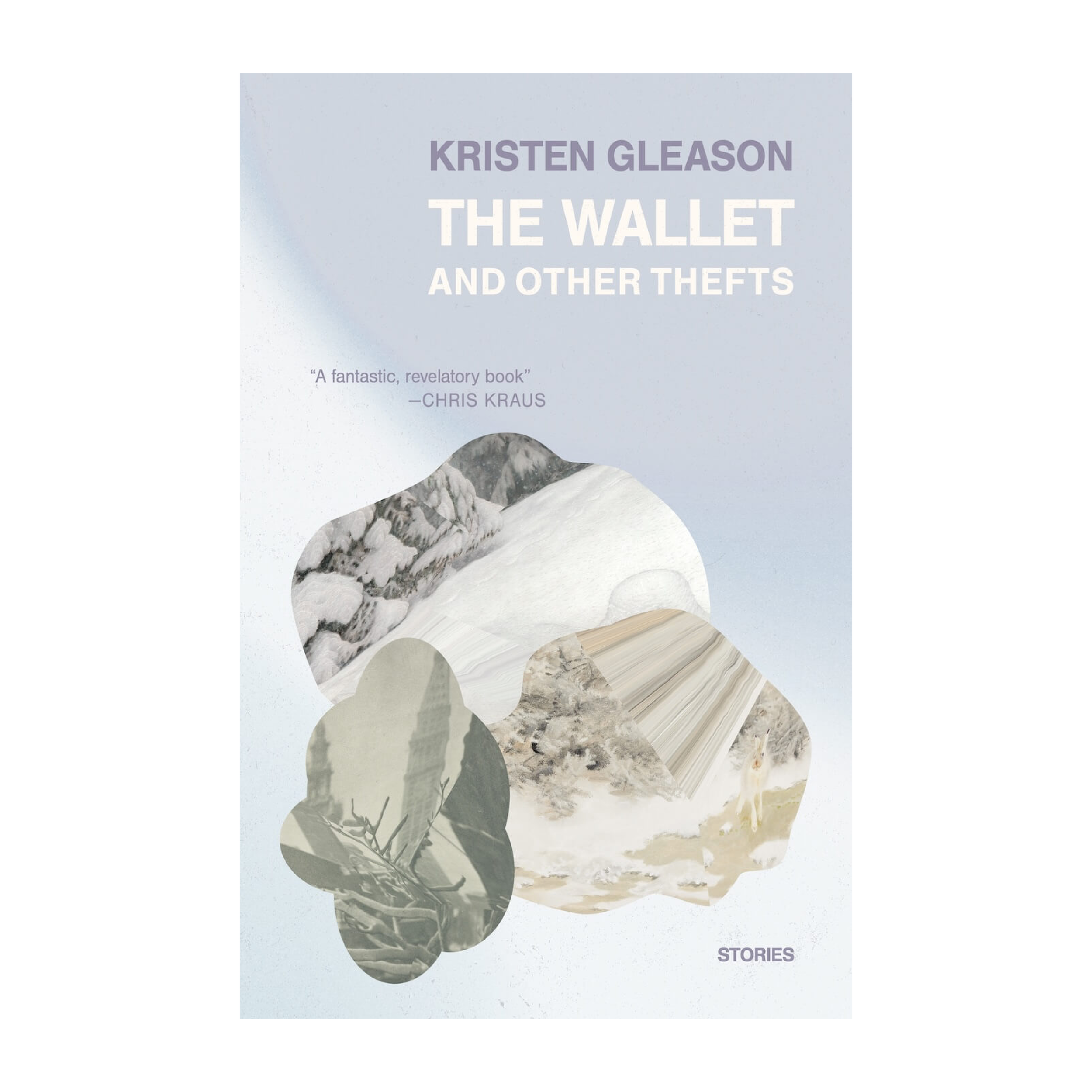
Kristen Gleason, The Wallet and Other Thefts. Fonograf Editions, 2026. 183 Pages.
Reading Kristen Gleason's The Wallet and Other Thefts feels a little like being robbed. I would know: it happened to me once, in Porto, during dinner at an outdoor restaurant. Like most tourists, I wanted to feel a sense of dangerous novelty; like most tourists, I believed myself to be immune to it. Perhaps because of this flawed logic, I brazenly hung my bag from the back of my chair. Only when the bill came and I reached for my wallet did I realize it was gone, along with my passport, sunglasses, and camera.
Of course, there was the procedural panic, the useless polícia, the pizza shop where we eventually ate as I cancelled my credit cards. But as we retraced the same sloped streets, looking for leads and finding nothing, I felt a brief flash of elation. I no longer had proof of origin or identity. The narrow reality that I lived in opened to a wide expanse. What would happen now, I did not know, and yet the not knowing was sweet. That was the thing about travel: it expanded what was possible for reality. And then there was the thought that, perhaps, I had deserved it. After all, I was a tourist, and like all tourists, a thief.
In Gleason's collection, travel is an act of theft, a robbery of local experience. Yet, experience must always be stolen, as “it‘s the only way to get it.” From tours of heterotopic dreamscapes (“Monument”, “The Wallet”) to small shifts in vision spurred by a stolen pair of glasses (“A Common Scene”, “Mumbai”), characters are transported from their rigid surroundings into a new way of looking. Throughout, Gleason is primarily concerned with the defamiliarizing vision of the traveler. Her subjects, strangers to strange worlds, are tourists, exiles, and people who search for an alternative to their own confined realities.
The collection begins in the most familiar of bourgeois settings. In “The Café,” three women sit at a sun-soaked outdoor café as they recount their travels. Yet it’s not long before the prose attunes us to a shade of instability hiding underneath the shimmering, solid surfaces of the ordinary. Their outdoor booth is a “semi-private cell”; the table they gather around is abrasively solid, “a bright white slab”; the male waiter, who “was always away but never sufficiently gone,” acts as a surveilling presence. This growing sense of confinement is contrasted with breaths of movement and instability. Coffee creamer comes in a handmade ceramic with a rounded bottom that won't “sit flat,” and the narrator anticipates an “imminent” spill. The café becomes personified, “spirit-like, always responding to its wavy medium,” and the walls of the booth are “made of curtains, sheer ones,” with no ceiling. Despite the overtones of containment in their described surroundings, the women remain “as they really were: quite free.”
Instability refracts throughout the collection. Nothing in a Gleason story is solid. Surfaces are made from light and liquid, their firmness illusory. In “Vacation,” a woman employed at a “gob” factory stays in a desert villa belonging to her employer and mistakes the fluidity of light for something static. “The sunlight was solid,” Gleason begins. Its reflection “off the sea hit like a heavy blade on the bridge of her nose.” Light is just as solid as the water in “The End of the Party,” where our first-person narrator is trapped at an unceasing soiree on a rich man’s estate. When the rich man’s wife sees a young boy drown himself in the river on the property, guests gather near the river as the host jumps into the water to try to save the boy, sinking “beneath the silvery impenetrable surface of the water.” The rupture breaks guests out of a charade of propriety and acquaints them with the sense of threat. Outside the book, the confines of our own shared reality start to seem more like contrived scripts of propriety at an exhausting social gathering: both are, as our protagonist describes in “The End of the Party,” “propaganda.”
Just as surfaces in Gleason’s stories are always far more permeable than they appear, we are never sure if we can take any of her descriptions at face value. Are the women in the café really in a space of ominous confinement, or is this just Gleason’s way of describing a café booth? Does the waiter really “flow” between the walls, or is that just the impression his movement conveys? “It seems to be made entirely of air,” says one of the women of the café itself. Here, even “seems” confounds us: does she mean that she believes it’s made of air or that it looks that way? We cannot be certain exactly when Gleason’s language veers into the imaginary. In another story, “Mumbai,” there is “the warm sink of the crowded town… the living boats. Every shrimp on fire. Every foot. Every fist raised and full of fish, dripping with the fluids of fish.” Are the boats themselves alive, or are they brought to life by their passengers? It is never clear. This entanglement of the figurative and literal achieves destabilizing, slipstream effects. Our understanding of the reality presented to us deepens with multitudinous possibilities of interpretation. We travel by seeing anew, by delving into richer dimensions of our surroundings.
Travel does not always have to consist of physical movement. Transport can, of course, occur through the imagination. “I’m feeling exactly like a prisoner. I need to take a trip,” says Ava, one of the three women in “The Café.” She begins to recount a past visit to Egypt, and just thinking about the trip allows her to “feel free.” Gleason’s story, too, becomes expansive, moving into extended reminisces by Ava and her companions. We roam from place to place, yet we are also still in the café, in the confines of a short story, sinking into the solid pages of a collection. “A bed is a portal,” says one of the guests from “The End of the Party.” So, too, is a book.
But freedom of interiority is a gendered notion in The Wallet and Other Thefts. Women are the ones with imagination, and they babble in the background of Gleason’s first-person male perspectives as minor annoyances. Our man in “Mumbai” can no longer stand his partner’s “dream chatter.” The wife of our protagonist in “The End of the Party” insists that she’s “marching for a cause” despite her husband’s imposition (and the story’s) that she’s alone in a conservatory. “You can’t imagine,” she says to him. This points to an epistemic difference between the genders. Not only do the men in these stories lack imagination, but they constantly seek interpretation, clarity, meaning. Women, on the other hand, are constantly questioning a world in flux. “Why did I…” Ava repeatedly asks as she tells of her travels in “The Café.” She has “no idea how” anything back then happened.
As “The Café” concludes, the waiter returns with the check, and the women give the waiter a coin with a “shifting color” that he cannot accept. Frustrated, the women attack the waiter. This surprise turn to violence stretches our understanding of reality within the story, and yet we find our fictive belief accommodating the sudden escalation. Perhaps the previous anecdotes of travel and transport, floating between mentions of surreal dreams and strange events, have by this point made the story porous to surprise.
It is worth noting that this is also when the seemingly impervious “bright white slab” of the table splinters in two: “what had appeared so permanent——that broad white surface, flawless as a field of salt——turned out to be anything but.” Reality breaks apart, and the women assert, “we will travel.. you can’t stop us.” The waiter then tells a story of his trip to Japan, where he opened an apple, “which was neatly hinged, and saw that the inside was an exact replica of his [my] childhood home.” He cannot help but add that the trip to Japan “meant that I might never die.” His sudden interpretation, an imposition of meaning, becomes another odd surface that constrains. The story leaves us with the feeling that nothing is so legible. Irresolution and uncertainty set the tone for the rest of the collection.
If women in Gleason’s stories are frequently trapped, yearning to be transported. As we move into the second part of the collection, Gleason’s male protagonists take on the subjectivity of exile. At times, their dislocation is obvious, as with Brian Ed in “The Refugee,” the eponymous character living in a small village after “the poison dropped and travel home became impossible.” At others, characters experience existential exile and ambient homesickness that has no physical origin. Take, for instance, the narrator of “Monument,” who suffers from a condition where “bowls” burst through his skin. Traveling through a green valley by train, he observes:
Sometimes the green would stop and it was as if a black horn had thrust through the earth, and the view would go dark and smooth… was it the head and the beak of a crow, was it a fall of hair or an iron spike, or a portion of my house, my ruined house——what was it? But the green would return, the leaf-green valley with its leaf-green mind, which could never be the home of my heart.
Colors juxtapose a verdant valley with the narrator's dark dislocation. Despite the lush beauty of his surroundings, our narrator cannot assimilate; he takes comfort in the “dark and smooth” blackness that reminds him of his “ruined house,” his body. The colors return later when two girls on the train, both named “B”, ask our narrator to tell them the history of the valley. Finding B and B attractive, our narrator hopes to impress them with some intriguing local lore. But he cannot. A foreigner to the land himself, he does not know its story:
I thought, This is where one would mine one’s memory. This is where one would pretend, where the fable would fill up with familiar friends… while I hurtled down the narrow green, how could I begin? I was away, I had always been. I stuck my hand into the ground and felt the fleshy snap of breaking root. To the deep. That’s where. In the bowl of my head. Through the window of the train——green, green, green, and black.
Black interrupts green, and the narrator inserts a part of himself into the landscape, creating a version of the valley with a black horn. Exemplifying Gleason’s destabilizing techniques, this story within a story again blurs lines between the figurative and literal scheme of the text, literalizing the imagined simile from the first excerpt as an actual attribute of the landscape in the second. By the story's conclusion, we learn the tale has real consequences for both landscape and narrator alike: “My home is black, my heart is black, my heart must rise through the valley's green. I must surface,” he laments. Black now penetrates green, as bowls emerge from our narrator's chest, infusing the last sentence, "I must surface," with multiple embedded meanings. Elsewhere, the black horn is described as “someone's impossible erection.” In the last line of the story, the narrator turns: "away from all women and waited for the thing to show."
Perhaps the most mysterious story in The Wallet and Other Thefts is the very first one I encountered by Gleason, “The Pale Pig,” originally published by A Public Space in 2017. The story begins percussively, with a popping sound as our protagonist, Mr. Pop, observes “that the paddock was empty. They had not left the body to rot.” Odd repeating “o” sounds in these lines lull us into the territory of nursery rhyme and fairy tale. Soon we meet Kiki, the young girl who Mr. Pop tutors, and her injured horse, Lump, the body not left to rot. We follow Mr. Pop as he moves through Kiki’s farmhouse, but then the story transports us to mountains, where a pale pig with a bottomless appetite sleeps. Strange details accumulate. Helicopters fly with giant, oppressive concrete columns that dangle in the sky. Mr. Pop has memories of offering himself up to the pale beast “like a package full of treats.” A “numinous foam” forms a white wave that carries the pig down the mountain. I read Gleason’s story——once, twice——transfixed by its lack of legibility, its precise yet unfamiliar images, its erotic and biblical fibers. Sound and color, rather than meaning, propelled me through the text, luring me in with its playful syncopations. The sense of disorientation I felt was fresh and pleasurable. I became disenchanted with the conventional short story that unfolded algorithmically in politely calibrated rhythms. As I tried to engage with the form through my own writing, I felt constrained by conventions that valued economy and clarity over wonder and expansion.
With a sleight of hand that steals reality out from under us, Gleason’s stories are an act of transport to a different state of fiction. We become lost, senses bewildered, regular consciousness stolen. As I read The Wallet and Other Thefts, I recalled the feeling of missing some necessary object needed to function in modern life, but ultimately inessential and false to my person. Yet, like all acts of theft, Gleason’s collection offers us something in return, an alternative perspective that becomes animated through inventive language. Or perhaps it is habitual perception that steals the sensation of life from us, and only through theft can we find it again. "And art exists that one may recover the sensation of life… to make the stone stony," writes the Russian formalist Viktor Shklovsky in “Art as Technique.” In Porto, I discovered that theft was a form of recovery that reminded me of the possibilities of my reality. Gleason’s inventions accomplish the same effect. With our loss of regular perspective, we return to the freedom of imagination that was always under the surface. The theft feels, “every time, like the miraculous return of something useful——even necessary——that you’d worried may be gone for good.”