Illusions of Wholeness: On Dorothea Lasky’s /Mother/
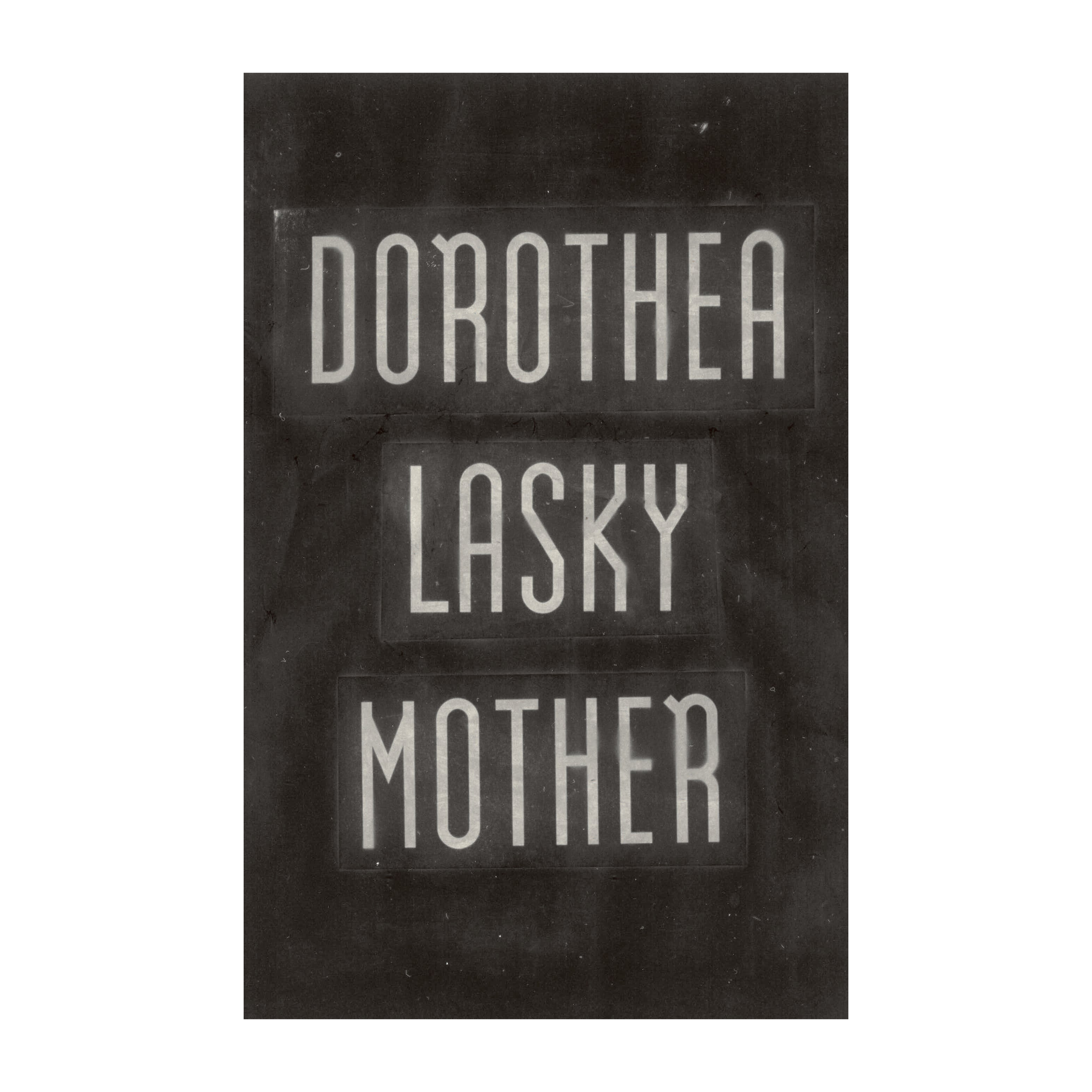
Mother, Dorothea Lasky. Wave Books, 2026. 88 Pages.
Mother, Dorothea Lasky’s latest collection of poems, is a breathtaking escalation of her singular, hypnotic voice and vast poetic mind. Lasky writes through her third pregnancy, turning her unwavering eye on the terrors of birth, the anxiety of mothering, and the grief that haunts creation. Infused with her love of the horror genre, Lasky’s vivid lexicon of color and image complicates expectations and stealthily opens doors. Mother is a spell-binding descent to a place beyond language, where uncomfortable truths can be felt, and from which a more expansive self might emerge. In an early eponymous poem, of which there are eight, we find that the image of “mother” conjured by these poems is not one made up “of the soft bedsheets / Of a grand nurturing,” or “the nice words of a person / Who loves you better than anyone,” but the terror “of a gun / pointed always / at my head,” the dread “of the quiet anger / that never goes away,” and the magnitude “of thunder and rain and the / Things that grow after.” Falling through these poems and allowing them to inhabit us, we find that this fear and rage does not result in passivity, and loss does not beget nothingness. Mother is a propulsive, awe-inspiring force driven by intense love and a demonic desire to create.
At the beginning of Mother, and in the first of the poems called “Mother,” we are greeted with a death-birth scene that is also a door:
The bird was blue and grey
Lying on the stairs
There was something
Moving inside of it
And still I knew it was dead
A simple image (“The bird was blue and grey”) is soon complicated, folding together birth and death, life and decay. By intertwining what we wish to rationally hold at two separate ends of a spectrum, Lasky disturbs the fabric of our expectations and creates an entry to something beyond language, “a kind of transformation / That can happen on any day”——that perhaps we prefer not to see in order to get through the day. This opening image echoes a quote from Hélène Cixous’s lectures Three Steps on the Ladder of Writing: “To begin (writing, living) we must have death.” Cixous explains that for a writer, death is the birth scene from which the desire, permission, and necessity to write emerge. Most spend their lives trying to forget these early scenes of death, but to write, Cixous argues, is a consistent effort not to forget, because the whole of life, and the truth of it, includes death; it includes passing through the door to which the dead grant access. In the same poem, Lasky continues, “You’d rather ignore / The holy body writhing / Knowing that inside of it / It’s calling out your name.” Perhaps the holy body is the poem inside of the poem——the soul of the poem, the mystery that moves you. Or maybe the baby bird trying to be born is the truth that will transform you. Whatever it is, Lasky alerts us to the fact that “It’s calling out to you / ‘Mother!’” before asking, “But will you save it.” Will you turn away from the image and spend the rest of your life trying to forget it? Or will you look at it and hold on to it forever, saving it in memory? Will you walk through the image to the other side and let it transform you? Lasky carries us through, and the poems that follow are colored by this memory of an image of life inside death.
“I am writing to you 10 weeks pregnant / God willing in 10 weeks / I will be 20 weeks pregnant,” Lasky writes in the second of the poems called “Mother.” Mother also takes inspiration from Bernadette Mayer’s The Desires of Mothers to Please Others in Letters, composed of formally experimental letters written from the summer of 1979 to February of 1980, when Mayer was pregnant with her third child. Lasky writes many of the poems in Mother through her own third pregnancy, and this epistolic poem documenting the early weeks of the gestational period——a time of expansion, development, and anticipation——simultaneously asks: “What does it mean to mourn / The fact that nothing escapes time.” Nestled within the recognition of life growing with time is the acknowledgment of time’s destruction of life and memory. The speaker mourns a loss of self: “That time will pass / I will still somehow be me / But altered / I won’t be the same.” Though, further into the book, in another poem called “Mother,” we learn that it is from this loss that the I emerges:
I’m here, I’m here
You said
A hole that goes on forever
Not the one you caused
But the loss of you——
The hardest lesson is that I came from that
I comes from the loss of you, like a baby bird moving inside of its dead mother. Maybe the holy body is the hardest lesson that can only be learned in time. The grief the speaker expresses in the earlier “Mother” poem over losing a former self with time’s passing might call to mind Heraclitus’s river, and a passivity in letting it wash over. In this later “Mother,” however, time is not a gentle stream, but “a river of rats,” and the speaker’s grief is transformed into courage and ferocity, a readiness to take action, and a willingness to cross over: “Yes I would cross the river of rats for you.”
In Three Steps, Cixous emphasizes that “neither death nor the doorkeepers are enough to open the door. We must also have the courage, the desire, to approach, to go to the door.” Lasky draws from her love of the horror genre to approach the images that frighten, and to open that door. Her previous collection of poetry, The Shining, was inspired by a lifelong fascination with the film from which it takes its name, and Mother, too, contains references to beloved horror films like Rosemary’s Baby and Suspiria. Images one would expect to find more readily in these films than in a poem stir up fear, calling forth a mixture of courage and desire that makes it impossible to look away. We are dragged further down into the subterranean world of the poem, where the metaphysical transformation takes place. The transformation that happens as we fall through a Dorothea Lasky poem occurs so subtly, one arrives somewhere completely unexpected without ever having noticed the moment of departure. This is why it is so tempting to refer to her voice as “hypnotic” or to her poems as “spells.” One of the vehicles for this mysterious occurrence is her deceptively straightforward language. Not that Lasky is trying to deceive us——rather, she is communicating with searing clarity the slippery and elusive reality of mothering and having been mothered. This experience, Lasky suggests, cannot easily be contained, can only be accessed through a poetry equally as slippery, contradicting and transforming itself in the way all real and complex things do. “Only by misspelling do I learn the real words,” she writes in the poem “Worst”——a mantra for discovering truth through strangeness and inconsistencies. This idea is exemplified literally, and pleasurably, in this stanza from “Mother”:
Someday all of the world will blow up in a curse
And so be it—
The difference between that and a cure
Is a tiny snake
Lasky’s poems welcome us with familiar, trustworthy language, inviting us to step inside, and we follow them along because the voice is mesmerizing, gripping our hand like a ferociously loving mother and guiding us through a door further into the poem, where almost without realizing we find we have broken through the familiar world of language and arrived somewhere much deeper. The real power of these poems is in their ability to inhabit the reader at their primal core, and that center is expansive, described in “The Lodge at Mount Rainier” as “the poem / That goes on forever, never said.”
Or take these lines as another example: “I’m wild / but I’m not evil / I’m not the evil teacher / Who sits at the front of the classroom” the speaker claims at the opening of the poem “Bad Teacher.” “I sit in the back of the classroom,” she insists——”It’s all so lovely and awful / This way of life.” And as we proceed further down the page, deeper into the poem, we find that:
Anyway something is wrong
With Mommy
Her head is just completely off now
She’s wild
And entirely evil
She sits in the front of the classroom
The unexpected complication is just like the misspelling that reveals the real, emotional world. The bad teacher is haunted by the evil mother, until further along and deeper, the two become one, or the one becomes split open, as in a fever dream:
I can sit in the back of the classroom
And see my severed head
Somewhere floating
It looks so angry
And even when I close my eyes
I can tell it’s still angry at me
The responsibility of the caretaker, and the inherent devotion and inevitable pain that comes with it, along with the anxiety and the self-criticism, it’s all so lovely and awful. And yet, “maybe caring for each other is the only way to heal. I still believe in that,” Lasky says in her essay “Horror is Joy” from Memory. “Maybe all we are is a witness to our joy and pain. And maybe a good horror story——a space where everything completely terrible is simply acknowledged——is a human embrace after all.” In The Letters of Rosemary and Bernadette Mayer: 1976–1980, Bernadette writes to her sister about writing the last section of Midwinter Day, right before she begins work on The Desire of Mothers to Please Others in Letters: “in the last part of the poem, where I had planned to talk about aesthetics, I wound up talking about art and family, writing and being a woman and my wonder at how little information about the past has been transmitted and made available to me through women, so I could know, say, what a mother felt like in the Middle Ages or even literate ancient Greece.” Mother may witness our joy and pain by simply acknowledging what being a mother, daughter, poet, teacher, and human being feels like in an age when “the very genre of horror isn’t a fantasy anymore.” But also, “maybe every era feels this way,” and maybe these feelings are ancient. Lasky’s I taps this ancient, primal space, leaving us with what Lasky describes herself as the “best gift that a poet can give” in the introduction to Animal, her book of lectures on poetry:
The best gift that a poet can give is to allow their I to be its own cool animal. An I that is a wild thing, a mercurial trickster that resists all definition, that is so close to a self (or the self)——and so far away from it at the same time——that the reader can’t help but see a real self in it. An I that is a self who makes so many contradictions, who manipulates the reader and their expectations to such a degree that the reader is left feeling both full and empty after having encountered it.
“Maybe horror itself is a space to heal,” Lasky says in her essay on horror. “Maybe if we turn to the art that frightens us still, we can make it all make sense.” In turning fully to what frightens her, Lasky embraces the entirety of motherhood, resisting any one-dimensional or easily contained narrative about what it feels like to be alive by allowing the I to be its own wild thing, cutting it open, and looking into the wound for the door, into the hole that goes on forever, endless Russian nesting dolls all disassembled to shatter the illusion of wholeness and to wake up to the realization in “The C-Section” that “When you’re whole, you can’t see.”
***
Cited
Cixous, Hélène. Three Steps on the Ladder of Writing. Translated by Sarah Cornell and Susan Sellers, Columbia University Press, 1993.
Lasky, Dorothea. Mother. Wave Books, 2026.
Lasky, Dorothea. Memory. Semiotext(e), 2025.
Lasky, Dorothea. Animal. Wave Books, 2019.
Mayer, Rosemary, and Bernadette Mayer. The Letters of Rosemary and Bernadette Mayer: 1976-1980. Edited by Gillian Sneed and Marie Walsh, Swiss Institute, 2022.