Beyond the Reach of the Poet: On Caleb Nolen’s /Afterlight/
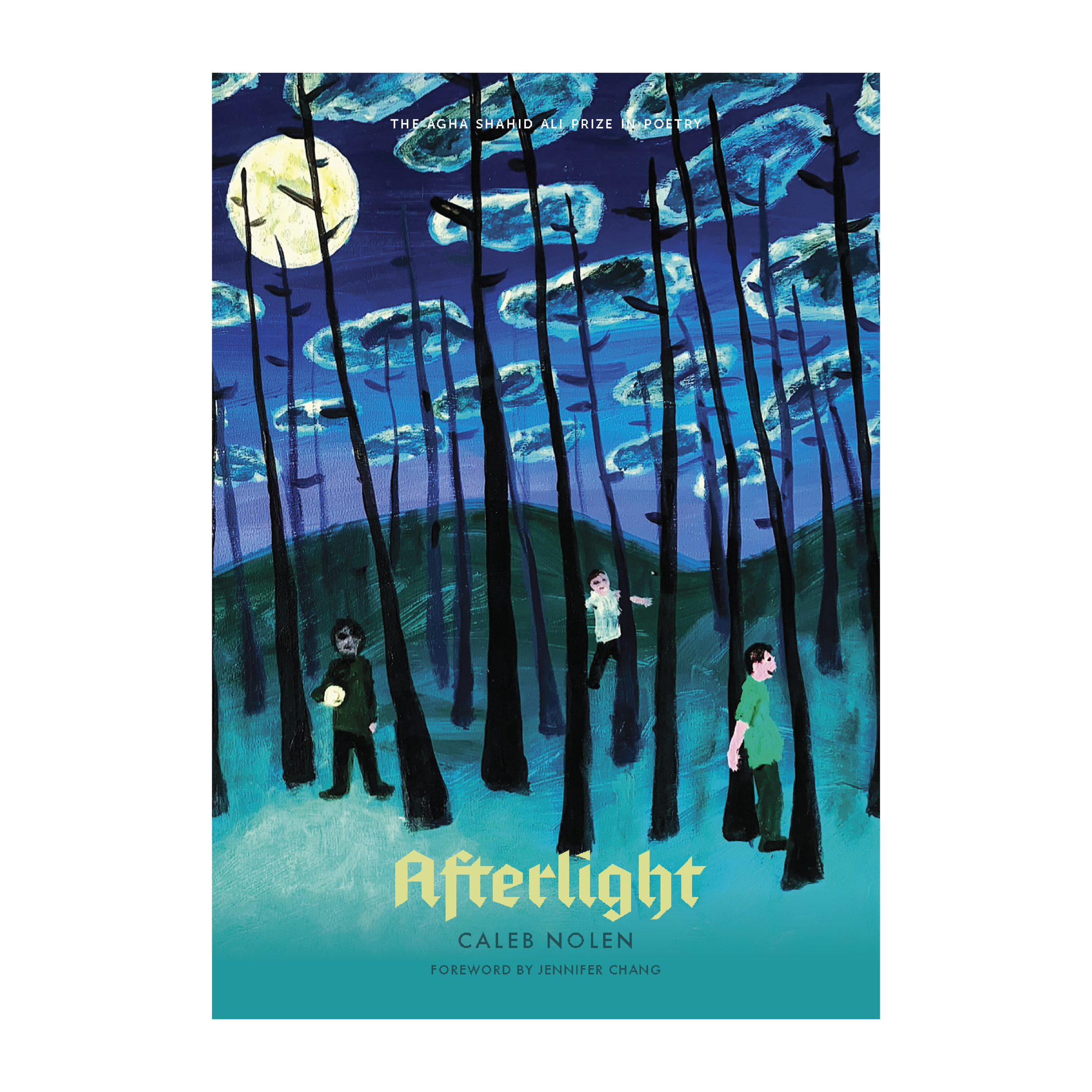
Afterlight, Caleb Nolen. University of Utah Press, 2026. 64 Pages.
“I managed not to die. I say I never will / as long as no one tears off my eyelids,” the speaker reports to his friends in “Reunion,” the opening poem in Caleb Nolen’s debut collection, Afterlight. Upon an initial reading, these lines suggest the speaker, who is consistent throughout the book, will become a kind of documentarian, achieving immortality through the act of witness. Nolan’s documentarian evokes Shakespeare: “So long as men can breathe and eyes can see, / So long lives this, and this gives life to thee.” It’s true that these poems want to elegize the adolescent boys crowding the speaker in this moment: their loudness, their anger, their cruelty and beauty. But the poems that follow complicate and challenge the morality of the poet who dares make art of a person’s life. Afterlight advocates for the complexity of its subjects as something beyond the reach of the poet:
I didn’t say anything about Bobby. Not when
I went home and saw my new friends,
not even when I went to bed with a womanwho loved me. I wanted his death to be his,
not some story folded into my life.I wanted to clear a space in my body,
as if he could live in it, as if he could be kept safe.
This passage from “Black Friday” articulates the speaker’s struggle: these neighborhoods are not dramatic sets, these people are not players, and their lives, their interiorities, are not metaphors. Yet by placing them in a poem, they adopt a figurative dimension. Nolen writes from this place of tension. How can we honor the dead and absent without flattening them? What is the responsibility of the witness, of the survivor? And if we do write about it, how can we do so without turning it into a spectacle? The title of this poem points to the charade we humans can make of what is sacred. Black Friday instead of Good Friday. A shopping spree, hordes of people in line at the Target instead of mass, a solemn reflection on and mourning of the death of Christ. Self-indulgence instead of sacrifice.
The poems in Afterlight suggest how easily one can turn into the other. If the poet’s indulgence is in description, then Nolen practices a verbal asceticism. The lines I’ve quoted here are given to us matter-of-factly, unadorned by adjectives. As Jennifer Chang notes in the book’s introduction, this is a product of “recognizing that language is most deceptive when it is beautiful.” For Nolen, it is already treacherous to write these poems; to embellish them with beauty would be a greater betrayal. Later in the book, in “Letter to Judas,” the speaker laments: “How humiliating // to say it now in poetry, to let other people / tell me that I’m good at it.” Yet the beauty still comes through——these are poems after all.
While there is much of it to be found in Afterlight——beauty in the dramatic situations of the poems, beauty in the tenderness of the speaker’s attention——I am most partial to the beauty of Nolen’s music. Returning to the two lines from “Reunion,” I admire their rhythm. They are almost completely iambic except for “tears off,” a surprising spondee, adding emphasis to the forceful verb. It also creates a natural caesura right before the surprise of “my eyelids.” Earlier I mentioned that on an initial reading the lines implied a documentary mode because it was only on a subsequent reading that I realized it is not the eyes that cannot be torn off, but the eyelids. The additional syllable, that feminine ending, creates uncertainty that echoes the strangeness of the image. It is not the act of witnessing that immortalizes the speaker, but rather their ability to close their eyes. In other words, to be able to sleep, to dream, (to die?) is what gives life beyond death. In his couplet, Nolen has complicated Shakespeare’s by pointing to the necessity of the poet’s imagination to create “this,” the poem that gives life to thee.
I’ve been putting Nolen in conversation with Shakespeare, but his main reference in Afterlight is the Bible. Epistles to biblical figures are scattered throughout the book. Stories of Cain and Abel, Job, and Judas illuminate the preoccupations of the speaker: violence, jealousy, faith in the face of suffering, betrayal. These letters are direct addresses in which the “source material used… has been modified for the [the poet’s] own purposes” according to Nolen’s notes. The epistles act as a conduit for both prayer and conversation. Like in “Letter to the Woman Taken in Adultery,” the speaker asks “Is this how you felt // when the Lord said go, and sin no more?” and in the final couplet: “outside, a dim glow in the stained-glass windows. // I’m forgiven now, I said, and I tried very hard to feel it.” Lapsed Catholic that I am, I did have to look this one up——her story is the one that ends with the well-known “let he that is without sin among you cast the first stone.” In this poem, the speaker empathizes with the woman, realizes that it is no easy task to leave one’s sin behind, particularly when the offenses seem so great that guilt says pain is the only way to pay your debts. Yet solace is achieved by the poem’s direct address, a confidence with the addressee. Thus, the letter becomes a way into both confession and mercy, prayer and response.
These epistolary poems’ titles announce them as such, as “Letters to…,” and each is exactly 14 lines long. All of them, except for “Letter to Paul the Apostle,” are composed of seven couplets where the second line of each couplet is indented. Thus the ghost of the sonnet haunts these poems as the stories of saints and sinners haunt the speaker. The sonnet is apt, given the history of the form as a means for both self-reflection and public pronouncement. The letter, when mailed, is the merging of a private conversation facilitated by the public state, and these poems merge the public lives of holy figures with the private meditations of the speaker.
The meditations wrestle with their own subjectivity. The poet is aware not only of the trickiness of memory but of all sensory experience. As in “Mondegreen [‘Out of nowhere Bobby…’],” where the boys argue over a Slipknot lyric, and the speaker must admit: “The truth was, I heard it both ways.” The truth of what happened between these people is impossible to find, “both through the act of writing and through the process of memory,” Nolen writes in his notes. Still, the poet’s urge is to try. In “Ode,” the speaker says, “Don’t let this memory be revised. Don’t make it / what it wasn’t,” eliciting how memory works in our brains: we literally rebuild the scenes each time we try to recall them. And though the speaker knows that the events of the poems are memories——“Afterlight” means retrospect——these lyrics occur in the present. In the first stanza of “Blackout:”
One day Dan will get a haircut, leave town,
and start to go by his middle name,
but right now we are fourteen.
The lyric becomes capable of resurrection as it speaks a world into existence. And by reading we are invited into this world. The physical act of our mouths shaping Nolen’s vowels becomes a reenactment of the poet’s moment of writing. Of course, we are different, as the speaker has changed since the events’ occurrence, and we bring to the poems not the poet’s history but our own personal stories. The tragedy is that a poem must sometimes prioritize emotional truth over factual accuracy due to the instability of memory. Some things are too precious, we cannot help but want to hold on to them exactly as they were.
In Afterlight, Nolen recounts a faithful search for forgiveness and understanding from a god who offers very little sign of such things: a man walking into the grocery store with his son, a knife left in its sheath, a stone. The answers to the speaker’s questions change from poem to poem. Sometimes it is clear but unsatisfying, sometimes it feels impossible to find. In exploring the tensions between life and art, Nolen shows us how complicated the world can be. But what makes Afterlight astounding is how the poems don’t just grieve this world, but love it. Like in “Last Rites,” when the speaker recalls an encounter with an old friend at a Blockbuster Video a decade before their passing: “but most vividly I’ll recall how he walked // through those aisles of comedy and horror / to say hello and offer his hand. How I took it, / then I snuck out of town without calling anyone.”