Tell Me An Angel: On Serena Solin’s /A Barer Sky/
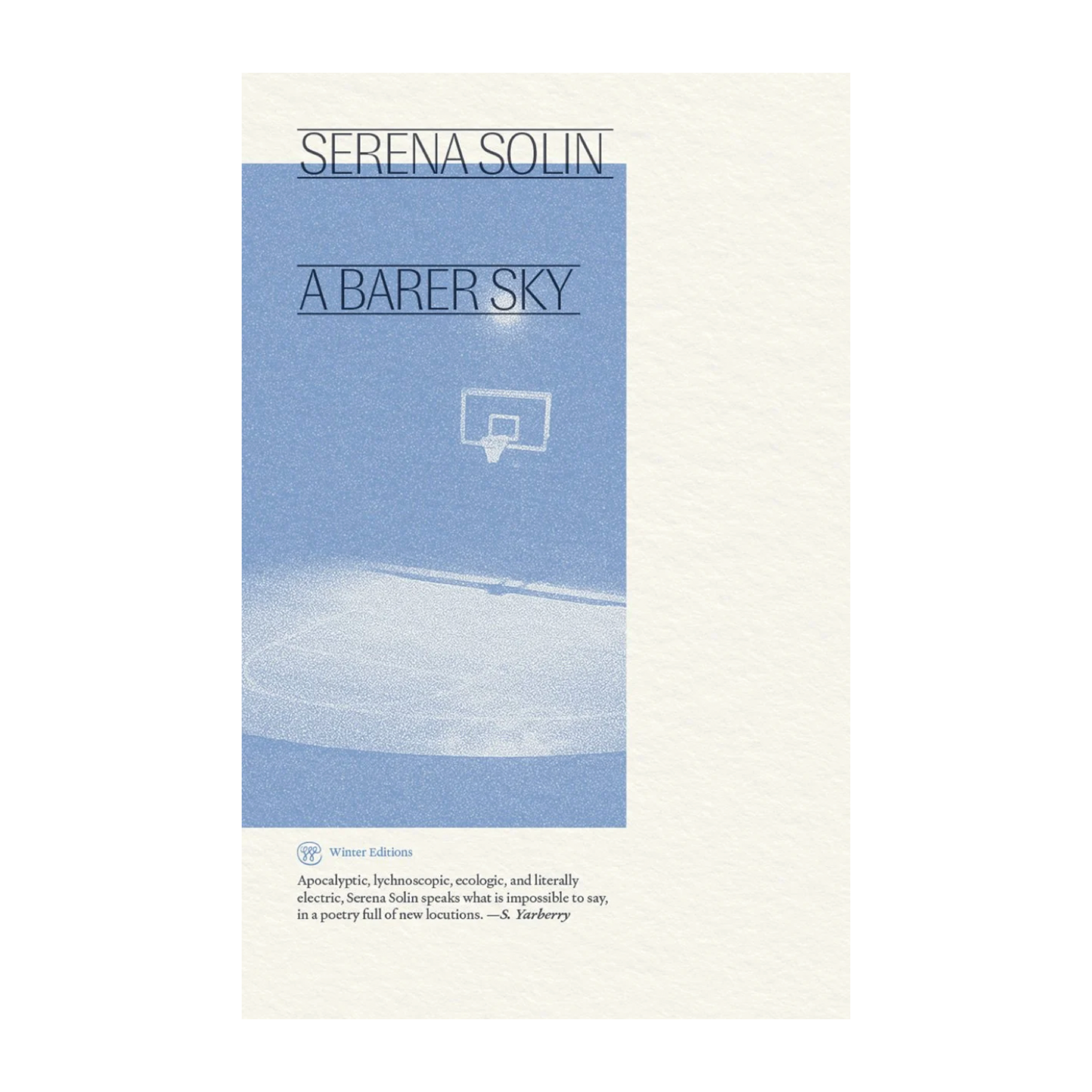
A Barer Sky, Serena Solin. Winter Editions, 2026. 200 Pages.
A short poem early in Serena Solin’s debut collection, A Barer Sky, presents a wonderfully double-sided metaphor for the mystical poet’s task. Its speaker remembers seeing a room “in the days of museums” that replicated the “simple quarters of the early Christians”; on its wall was “a painting of precisely that room / but in that image, annunciation.” Angels are the subject of the first section of Solin’s book, but these lines are the closest we get to actually seeing one: the suggestion of a figure in a painting hung on the wall of a dummy room in the speaker’s memory of a bygone museum’s display of a bygone species of faith. There are a dozen layers of remove between reader and angel, and yet it is also through the invoked painting that those layers telescope a glimpse of divine presence. Go ahead and imagine a painting of the room you’re in right now (don’t worry if you’ve imagined a replica). Now imagine it transfigured. Tell me an angel, the poem concludes, a trick of the light.
A Barer Sky is full of these tricks of light. Solin’s poetry exists in the space between the sacred and “the law,” which for her means just about any way that human beings learn how to be human. Solin tends to evoke this liminal space by collapsing it. A central motif of the collection is the “lychnoscope”——the small external window in a medieval church through which lepers were permitted to observe and receive communion. This makes for another elegant doubling of distance and proximity, turning the church’s walls into both a literal structure of injustice and a narrow window onto eternity. In the long multi-part poem “The Squint,” the speaker invites the reader to join her outside the lychnoscope’s window. “Each of us has done / Something unspeakable / To be here,” she confesses:
Though it appears
That those who would observe the altar
Freely, unencumbered
By our jailhouse window
Have already moved on
& so, at the Chalice
We are the only ones left looking
Here is another empty room of the past, filled with the longing of the present’s gaze. And before leading us to the walls of this old church, Solin has provided her own contemporary mythology. The speaker of “The Squint” is sent into the belly of a housing project’s boiler room, to reignite the pilot. Through the boiler’s lychnoscopic window (or “squint”) she would see a contained fire, if things were working properly; and she knows that the very air she is breathing would ignite if the man she works with flips the power on. Though of course she needn’t be too concerned; they’ve gotten drunk together before, and by this point they “nearly speak each other’s languages.” The relationship of self to other is also at the heart of this poem, and Solin knows that the window between is frequently one-sided. “The Squint” is a spectacular miniature epic——at once a Dantean descent into the depths of the soul, a vertiginous view of American history from “sugarscrubbed” genocide to the sterile light of department stores, and a feat of poetic imagination that compasses both “a language understood by cats” and a machine’s millenarian dream of “a day / Of sudden & incredible voltage.” That Solin manages to connect this material unpretentiously, and with consistent wit and warmth, is a testament to the remarkable clarity of her poetic voice.
The personal stakes of that clarity come into view in the eponymous poetic essay “A Barer Sky,” written on the poet’s loss of her newborn child. With an almost unbearable humility, Solin begins by casting this tragedy as one of many occasions that might lead someone to write with an unshakeable need for answers. The essay is both an examination of her own grief, and a closely intertwined attempt to locate the ideal of poetic insight; at the heart of each path is the question of whether language is adequate clothing for the soul. Solin does not pretend to have the answer for this question, but she does have ample wisdom. Drawing from her experience as a printer, she suggests that a radical life might be akin to the typesetter’s experimentation: “Set type reiterates centuries of orthodoxy even when it is broken and masterfully or experimentally remade, so too the soul and all it is capable of thinking.” This thought offers little solace for honoring a life that has not had the chance to express itself in language, and Solin holds its contradictions carefully. “Writing is associated with logic, law, power, and depersonalization,” she knows, “and the implications are grim. [...] But in writing he becomes more like he was.” Both the essay and the book take their title from Wallace Stevens’ “Anatomy of Monotony,” a poem which sets spiritual joy and bodily desire against the half-perception of a “barer sky that does not bend,” and into which both humans and the earth must eventually fade. Solin’s writing is a beautiful elaboration of this double knowledge, with equal emphasis given to the world of human tenderness and to the separate world of loss.
Somehow, neither the transhistorical looking-glass of “The Squint” nor the metaphysical elegy of “A Barer Sky” has the honor of being Solin’s most striking poetic experiment. That belongs to “Notes On Self-Reliance: A Poem for Two Voices,” an extended re-writing of Ralph Waldo Emerson’s 1841 essay that is staggered across the book in six parts. The formatting of the title announces the form——Emerson’s essay is reprinted in full in gray type, while Solin provides a second voice in black. The result is a dialogue in which Emerson’s ideas are annotated, modified, subverted, elaborated, and riffed on by Solin’s additions. After an initial shock (who does this!?) I found this to be an entirely delightful read. The distinction of the two voices means that the reader is asked to fully inhabit Emerson’s ideas, while Solin’s counterpoint thinks both with and against them. At times this makes for theatrical conflict, as the old transcendentalist drones on confidently while his interlocutor rolls her eyes:
Ah then, exclaim the aged ladies, you shall be sure to be misunderstood! Misunderstood! It is a right fool’s word. Is it so bad then to be misunderstood? Pythagoras’ wife was misunderstood, and Socrates’ wife, and Jesus’ wife, and Luther’s wife, and Copernicus you get it, and Galileo thought comets were an optical illusion, and Newton died drinking mercury, and every pure and wise spirit I knew that ever took flesh was made to eat it later on. To be greatly influenced by men is to be misunderstood as in their service.
This passage’s turn from a pointed feminist critique to a sober and equally feminist reframing is representative. Solin does not idolize Emerson, but she does takes him in earnest, and her reading is as generous as it is original. More frequent than her readerly objections are her subtle subversions, in which Emerson’s moral certainty is recast as a heroic but tenuous posture:
I will stand here on the precipice for humanity, and though I would make it kind of not exactly the way it is, I would make it truer.
Here and elsewhere Solin gently wonders whether Emerson’s hopes for humanity are not self-deceived, whether he has not mistaken the strictures of an intricate social fabric for the weakness of an unthinking herd. In other words she takes his hopes as something like the painted angel in the museum room: a gesture at spiritual truth that relies on imagining the world as “kind of not exactly the way it is.” This may suggest a retreat from some of “Self-Reliance’s” claims, but it also recasts Emerson’s thoughts as more radical than he may have conceived——or at least, than they may sound today. When Emerson calls for a revolution in society, Solin thinks alongside him to consider the implications:
It is easy to see that a greater self-reliance——a new respect for the divinity in man——must work a revolution in all the offices and relations of men; [...] The risks are enormous: a lodestar can only be observed from a measured distance; you must walk both within and beside yourself.
Given Solin’s wariness towards the self’s inherited formatting, this double-voiced and collaborative form of writing makes perfect sense for her own poetic vision. Blending her writing with Emerson’s allows her to “walk both within and beside” herself, an ideal that resonates with Emerson’s even as it undermines his title’s thesis. Her annotations filter his bold individualism through “A Barer Sky’s” knowledge of the soul’s reliance on “centuries of orthodoxy”; to put perhaps too neat a bow on it, her rendition is Emerson but in a different font. In the end he is but one of Solin’s many poetic interlocutors, and the creative evocation of his voice in “Notes On Self-Reliance” establishes her broader goal of meeting, honoring, and thinking beyond her influences.
The joys of this tremendous debut collection cannot be contained in an account of its more show-stopping experiments. The nine lyric sections that surround the six parts of “Notes On Self-Reliance” are each made of loosely interconnected short poems, which offer a greater range of memorable voices and imagery than any reviewer could do justice to. Solin’s writing is by turns wryly contemporary (“I ceded control over my orgasm to no one / but I admit I loved the two-door Civic / its intelligible parts, its idiosyncrasies”), philosophical (“Everyone / told us there was more [sand] than we could count // but you can count, in fact you must. Our grammar / requires counting”), and searchingly apophatic (“Though I knew it could not exist, I made a book of all things and then, of course, overwrote it”). The impression I was left with as a reader is that of a finely tuned poetics of attention, and of a poet as comfortable in the language of metaphysical questions as she is in “reaching / Into the heart, away from the words.” A Barer Sky hangs lightly in the space between these two modes of thought; no reader will come away from it without a clearer sense of how to move between them.