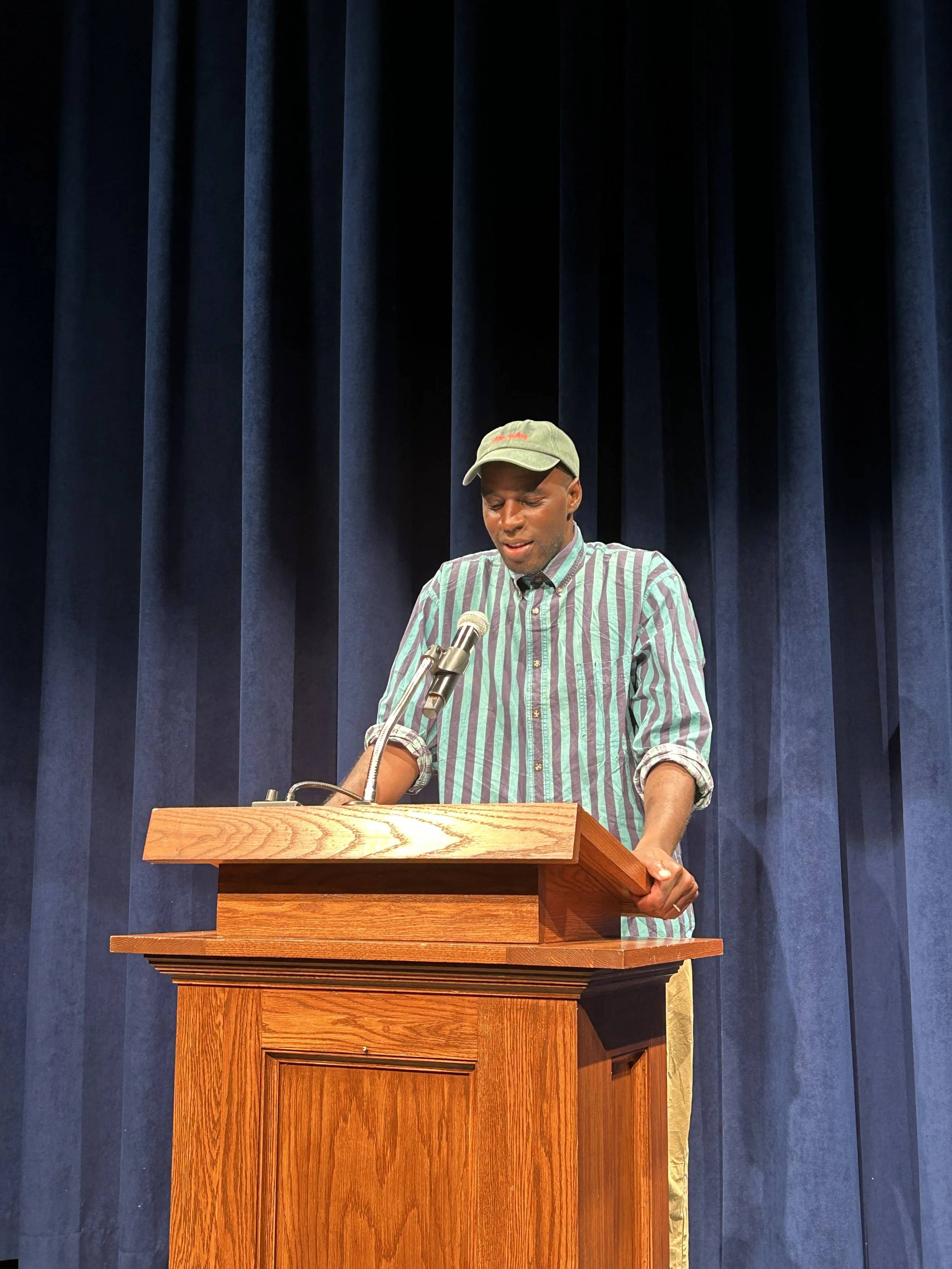
Imani Elizabeth Jackson, Flag. Futurepoem, 2024. 104 Pages.
It would not be inaccurate to call Flag a volume of ecopoetry that considers the movement of Black peoples alongside the movement of bodies of water and of trees. But the deeper awareness or spirit that animates the collection is harder to distill in a gloss of the book. This is because Flag comes bearing more than history or a poetic argument. Like Dionne Brand’s A Map to the Door of No Return (2001), it is a “note towards belonging.” Jackson reckons with uprootedness and drift in the wake of modernity’s evacuations of place and unearths her own discoveries in the recursive movement of life.
The collection’s title and its opening poem play with our assumptions about flags, revealing that the forms of belonging they signal are not fixed. The ongoingness of the world offers up specters of other meanings. The “untitled” piece at the start of Flag opens with four short snapshots: “And what of flags? I refuse the immediate meaning. I wrestle the word down to the ground and find life seeping up.” After this confrontation, a looser developing syntax holds sway, as if the liveliness under earth could rise into the page:
Wild iris, marsh herb, calamus, fabric signal, the tail of some dogs, the tail of some deer, something rippling or wagging. . .
This litany of imagistic echoes is rooted in the natural world. Still, I appreciate the way Jackson turns her attention from the ontology of the objects to a wider appreciation for what it does, how a tail might wag or a roadside iris might ripple, imprinting an emotional layer onto the act of looking. Later, this long sentence flexes out of its own rhythm into a different form of inquiry. Moments of syntactical instability culminate in a break that insists on remaining a continuation:
I’m looking to a porous and fluid border, where the boundary cracks and green pours through, herb to mouth, to quilt to stone, water tucking into the bends, all this motions fills in! to flag or hang loose, to tire, decline, to hail, raise a concern. . .
The realization’s eruption into a rhythm threatened by predictability galvanizes the engine of the sentence. Jackson is attentive to placidity and flow in the surface appearance of the world, and responsive to moments of fracture that wake the world up inside itself. Likewise, the turn in “untitled” toward the dictionary “definitions” of “flag” surface the internal contradictions within the word which contains both hanging loose and hailing, declining and raising a concern. What happens when a flag furls or unfurls, is half raised or cast out on the water?
By way of elaboration, Jackson offers five long poems and a short “erasure” of Alan Lomax’s memoir The Land Where Blues Began, all of which present different experiences of movement between water and land, boundedness and flow. All these sections dredge up luminous artifacts with re-reading, but I am attending here to the mixture of lyric poetry and musical ethnography that constitutes “The Black Bettys,” the third section of Flag. The second section of the book is “Land Mouth,” a magisterial lyric essay that braids the poet’s own family history with the history of intervention and extraction on the Mississippi river and in New England where the poem was written. Meanwhile, the third section attempts to trace the lineage of the blues song “Black Betty.” The song has many popular renditions including Leadbelly’s version in the Smithsonian Folkways collection, a 1977 record by American rock band Ram Jam, and recently, as the name of a singing duo from Atlanta, Georgia. Jackson’s investigation of the name’s long breadcrumb trail begins with a version of the song in the Library of Congress’s collection of “prison work songs,” contextualized by John Lomax’s commentary:
They say it was a tree cutting song, sung by men on chain gangs in the south. John and Ruby Lomax recorded Mose “Clear Rock” Platt singing “Black Betty” on May 10th, 1939 in Taylor Texas. . .at one point early in, you hear John in the background, prompting Clear Rock on a verse he wants to hear—
John Lomax: Black Betty had a baby!
Clear Rock: Black Betty had a baby, bam-ba-lam. . .
What follows is a text-based reproduction of Clear Rock’s performance of “Black Betty,” which appears verbatim, then slowly merges with Jackson’s voice. Jackson’s choice to reproduce the performance exactly makes me think of the question that Fred Moten asks about violence and performance in the first chapter of In the Break: The Aesthetics of the Black Radical Tradition (2003). Moten meditates on the scene of Aunt Hester’s scream from Frederick Douglass’s Narrative. In that scene, Douglass recalls seeing his Aunt Hester whipped by her master and describes her “heart-rending shrieks” in detail. Moten considers the sonic materiality of this retelling and notes that the performance is “unavoidably reproducible.” Even if one chooses not to represent the text exactly, “the beating is reproduced. . . in both the ritual performances combining terror and enjoyment in slavery and the fashionings and assertions of citizenship and ‘free’ subjectivity after emancipation.”
Clear Rock’s performance is compelled by John Lomax’s desire for a recording that does not imitate radio artists, and Jackson’s reproduction of Lomax’s request admits the sedimented layers of coercion, enjoyment, and force that exist in even Clear Rock’s calm articulation of the song.* Jackson’s transcriptions lean into the “unavoidably reproducible,” revealing that even exact reproductions have room for gaps. Her close look at the performance, including Lomax’s off-mic intervention, eventually widens to probe the open question of who Betty “was.”
Jackson begins by considering the slowness of Clear Rock’s rendition and how resistance might be encoded in it:
Clear Rock’s recording ambles at a slow pace, slower than Leadbelly’s. . . was it slow work Clear Rock did on the chain gang—lifting the axe, swinging the axe, felling the trees—despite the rush of the whip.
The poem then moves to consider how coercion might be encoded in the repeated summoning of “Black Betty.” Clear Rock tells John Lomax: “Black Betty was an old nigga woman on that Goree farm right out from Huntsville. . .” Elsewhere Jackson mentions the possible euphemisms that have been attached to “Black Betty”: “a whip used in Southern prisons, a motorcycle, a musket, a bottle of whiskey, a wagon that transfers prisoners.” In a stroke of genius, Jackson turns to the river birch, “all river birches being black birches. . . the only birch to grow in the south, disdained by loggers for their knots and spindles.” The scientific names for these birches? Betula nigra, which in Jackson’s playful ear, sounds like a Southern girl’s name. “The summoned Betula being a Black girl sitting lazing thinking drinking by a river as the sun goes down.”
Flag offers the poet’s taking up of the reproduction of the performance from the perspective of the feminized subject whose ability to name was restricted. Considering the preponderance of male voices describing “Black Betty,” Jackson’s poem, which I also read as her version of the song, carries the lyrics differently, layering the uncomfortable objectification of the song with a speculative fullness of the character’s thoughts and positioning in space. The introduction of Black Betty’s baby, stilted and forced out of Lomax’s coercion, brings us back to Jackson’s river concerns. Transposing “Betty” from a character who cuts down timber to Betula, a tree whose bark is knotted and resistant to human use, suggests that ecology can point toward strategies for survival in the face of destruction. It’s also moving to think that river birches “drink river water,” like Betty’s baby does.
Jackson’s etymological speculation on “Betula nigra” bears out a striking range of possibilities. The deliberate turn to slower thinking, and to taking the sounds we have been given apart to find old meanings nested in them toward new possibilities is Jackson’s practice of liberation. In her seminal essay “Mama’s Baby Papa’s Maybe: An American Grammar Book,” Hortense Spillers considers the space of having-been-named that constitutes black womanhood: “In order for me to speak a truer word concerning myself, I must strip down through layers of attenuated meaning … and there await whatever marvels of my own inventiveness. The personal pronouns are offered in service of a collective function.” Jackson’s progression toward new names strikes me as a similar movement from the individual creative act to a discovery of collective inventiveness.
The poems in Flag invite me to engage with outside texts, and I experience Jackson’s slow development as a complement to Flag’s intertextuality. Every section of the book showcases many-paged, layered development that accommodates other voices generously. Jackson often digresses to consider what else a word could mean, and that linguistic curiosity spills into her openness to kinship with the natural world. In the same way that we discover that Black Betty is not just a singular subject but a whole host of trees, the voice in Flag is Jackson’s weaving of many forebears, literary, musical, and familial. It’s fitting that the book ends with “Slow coup (for ancient music)” a response to Amiri Baraka’s Low Coups; the whole collection moves like water slowly gathering to overthrow calcified meaning.
Notes
* “John and Ruby also returned to Central State in 1939, but Ruby wrote that the ‘trip was fruitless’ because the "old crowd had scattered, the new boys sang fewer of the old songs and in performance imitated radio artists.” East Texas History (https://easttexashistory.org/items/show/36)