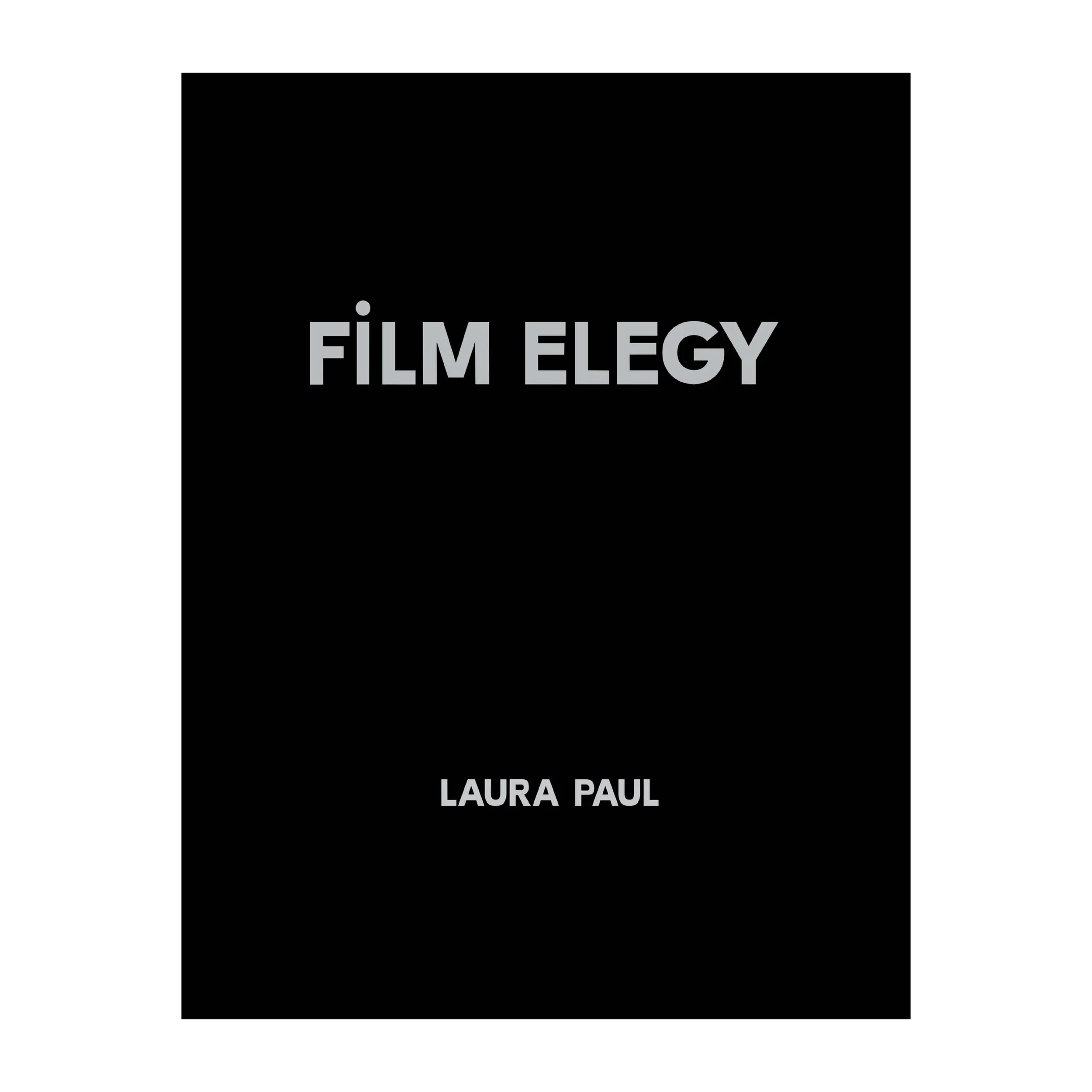
Laura Paul, Film Elegy. PRROBLEM Press, 2024. 124 Pages.
“The following book has been modified from 16mm. It has been formatted to fit your page.” So begins Laura Paul’s book Film Elegy (PRROBLEM Press 2024), an elegy and an encomium to celluloid as well as to the deceased American experimental filmmaker Amy Halpern (1953-2022). Printed on thick, black Kelsey Excelsior Model O letterpress and bound using Chicago Screws, Paul’s book is as much an art object as a dirge for her deceased mentor. With the recto text in a white box, followed by the verso in all black, Paul’s mise-en-page mirrors the structure of 16mm celluloid, as well as the architecture of a theater. This is a book that demands to be both viewed and read. Her poetic fulgurations flash across the page like lens flares.
A performer, filmmaker, and trained dancer, Amy Halpern remained an influential figure in avant-garde scenes throughout her forty year career. She founded and operated The Collective for Living Cinema in New York and the Independent Film Oasis in Los Angeles, while also teaching at several universities including The University of Southern California Department of Cinema for seven years. She shot her non-narrative films almost exclusively on celluloid, including her hour long feature-length Falling Lessons (1992), a montage of almost 200 faces captured by vertical pans. Ludic, gestural, and dizzyingly inquisitive, Falling Lessons, as well as Halpern’s films writ large, associatively interrogate the gaze’s relationship to, and framing of, gendered or racialized bodies and explore the elements (water, smoke, earth) and non-anthropomorphic forms.
In Elixir (2012), the camera slowly pans down a pregnant woman’s naked body as she gulps milk from a bowl. The bright liquid cascades down her swollen breasts before cutting to close-ups of sediment in water or a swimming fish. In Birds in the Window (2020-2021), Halpern cuts between various still shots of a window as a man (her partner David Lebrun) reads aloud offscreen. As a movement flits across the window pane, Halpern interrupts Lebrun, exclaiming, “bird!” The rest of the film detours into a delightful portrait of the small creature flying in and out of the frame juxtaposed against Lebrun’s staid and scholarly text. This preoccupation with the frame——and the movement contained within it——enriches Halpern’s films with a generous attention. Through her capacious cinematography, she recurrently (re)discovers the expressive potential of, and indissoluble connections between, indexical images of objects, material bodies, and light.
In the 21st century, wherein digital filmmaking and media is ubiquitous, the argument has long been made that analogue technologies are now obsolete. “Film is no longer a modern medium,” D.N. Rodowick wrote eighteen years ago in The Virtual Life of Film, “it is completely historical” (93). Yet, celluloid, “the passing present,” is also, according to American philosopher Stanley Cavell, a record of “things that are not present” (18). This material thus presents an inherent temporal paradox. In a theater, we bear witness to the film in the present tense as the images flash before us; yet we are also viewing a record of objects mechanically captured and preserved on cellulose nitrate from the past. Such a contradiction evokes Derrida’s assertion in Archive Fever that “the archive is spectral. It is spectral a priori: neither present nor absent ‘in the flesh,’ neither visible nor invisible, a trace always referring to another whose eyes can never be met” (84). The cinema straddles two adjacent worlds like a séance: conjuring a luminous ghost on screen.
From the Greek elegos, meaning ‘mournful poem,’ Paul’s prose is both poetic and theoretical, lyrical and historical. Formatted to look like words projected in a movie theater, Film Elegy is not just a book about Halpern, but also about the death of cinema as a celluloid based art practice. In short stanzas of verse, Paul addresses Halpern's work, film history, and the representation of women on screen in Classical Hollywood. 20th-century urban signage inspires the interior font, like that of many historical cinema spaces. As Paul tells me over email, the designer of the font, Julieta Ulanovsky, said she wanted to “rescue the beauty of urban typography.” Paul continues, “The cover font I pulled out of intertitles from Godard's films, Masculin Féminin and La Chinoise. People have commented that in La Chinoise, Godard foretells the political events of May 1968. In Film Elegy, I revolve on this idea of ‘the end of Hollywood.’” In mourning her mentor, Paul mourns an art form from a bygone era while also simultaneously reviving that aesthetic in the book we hold before us.
Early in Film Elegy Paul writes,
Gone gone | the clanging | of film reels
of real celluloid film | that leaves a chemical stain
on the hands.
Do you see my words project by? What else matters.
This interstitial interlude | we call being alive.
The “clanging” of film reels becomes a death knell in Paul’s memory; the evocation of chemical stains on one’s hands like something from a monster movie, odorous and swampy as exposed seaweed at low tide. Celluloid is a zombie, a body revivified by the running projector before returning to an inanimate, darkened, and lifeless state. Though cinema is composed of 24 frames per second, being alive and human, off-reel, according to Paul, is also an interstitial space. Our lived experiences constitute all the moments in-between returning to the theater. Everything is ancillary to the space, and primacy, of cinema.
Paul later asks “Is there anything living ever?” She continues,
Amything you were
one second of film
one sprocket on the strip
not an encore | a show
a whole production.
Processing Halpern’s death becomes the “whole production” of Paul’s life, underscoring the book’s themes of life and death, exhibition and obfuscation. “As if you are not active- / ly here | in my heart memory mind,” she writes, “papers computer things.” But Halpern is not just a part of Paul’s brick and mortar archive on and offline. She’s also a part of what Juliette Singh calls a “body archive”: the memories and material detritus that physically or psychically infiltrate a corporeal body. “Body? Cells Where else do you reside?” Paul questions. “In flames | dirt*****dust*****and ashes. / This is how I see you cremated,” Paul continues, “*******A***M***Y******* / Forever engulfed in flames | in smoke.” Halpern’s work and memory help construct Paul’s own body of work, igniting Paul’s inspiration and subsequent output.
Fire recurrently appears in Paul’s book. “Entertain us,” she commands Halpern “with fire***** and light.” Later she lists, “Bulrush and sedge / The copal,” continuing, “I burn***** / for you.” The connotations of “burn” are multivalent, intimating both destruction and inspiration, anger and ardor. Halpern underscores celluloid as a highly flammable material in her short Cigarette Burn (1978), a film that concludes with the end credits smoking from the flaming rose of a cigarette. Fire is a key risk one takes in projecting, and preserving, 16mm film. In 1946, Denise Ballon’s photograph of french archivist Henri Langlois’s “bath-archive” (a collection of film reels stored in the tub) satirically illustrated the deleterious precarity of amassed nitrate reels, as well as their potential liquid salvation. Paul’s book courts that precarity, demanding both light (from the projector) and enlightenment (from Halpern’s films). “My unstable nitrate heart!” she exclaims, “So read|y to ignite*****.” Cleaving the adjective “ready” with the verb “read” Paul once again calls attention to the intertwining of visual and textual media within her own book. Her heart, like Langlois’s bath-archive, is almost full to bursting.
“At least one copy of my book burned in the ongoing fires in LA, which are some of the most destructive in California history,” Paul reflected over email in 2025 when connecting her Godardian cover font to the Parisian riots of 1968. Over the weeks, as Paul and I corresponded, homes in Pacific Palisades, Altadena, and Pasadena burned. The city of angels lit up all our digital, individual screens, recalling the moment in Film Elegy when Paul asks,
What is consciousness? Amy, do you know?
Are you roping around right now? Golden,
MGM | or Goldwyn. You are a gold wind now
winding and windy | most of our days
spent on the screen | in the theater
of refracting light | of lightbulbs shot into flames
and the gilded palaces |
of fortune | of entertainment *****
like temples | labor temples
to a collective art
Like smoke, Halpern permeates Paul’s consciousness as a “gold wind,” winding in and out of the periphery of Paul’s sight——and mind. But we are not in the Golden Era of Hollywood circa the 1930s, we are in the present moment bearing witness to cinema and Halpern’s past. The metaphorical marquee that Paul conjures bears only Amy’s name. Paul wants to “turn [her] grief. [Her] suffering. Into a / |non| Hollywood production” from the “pre-code era” where all the ugliness is out in the open, uncensored. But, like a Hays Code film, we ultimately must use our imaginations. Paul’s book, unlike Halpern’s films, is all text, no images.
While Film Elegy meditates on the end of the Classical Hollywood era, the age of the Anthropocene started shortly before this cinematic shift, a fortuitous coincidence that links great acceleration with both climate change and new ways of seeing. If the archive is hypomnesic, then catastrophes wrought by global warming only amplify that ongoing erosion of collective memory. En masse the overall destruction encompasses a loss of life, memories, and artworks. In the experimental film world, Halpern’s death also leaves, like the end of Cigarette Burn, a gaping hole. What can we do in the face of these losses? To memorialize and concretize the artists and mediums that matter most to us is but one solution; which is to say, to bring the past to bear on the present again and again.
Film Elegy offers no promises as to what this exercise might yield, but it does illustrate the practice and performance of remembrance through both its content and form. “Amy, what is consciousness?” Paul recurrently asks. “If I channel you can I feel things? Sense things?” The next line proffers no answers, just the adage “remember you” which cinema always already preserves.