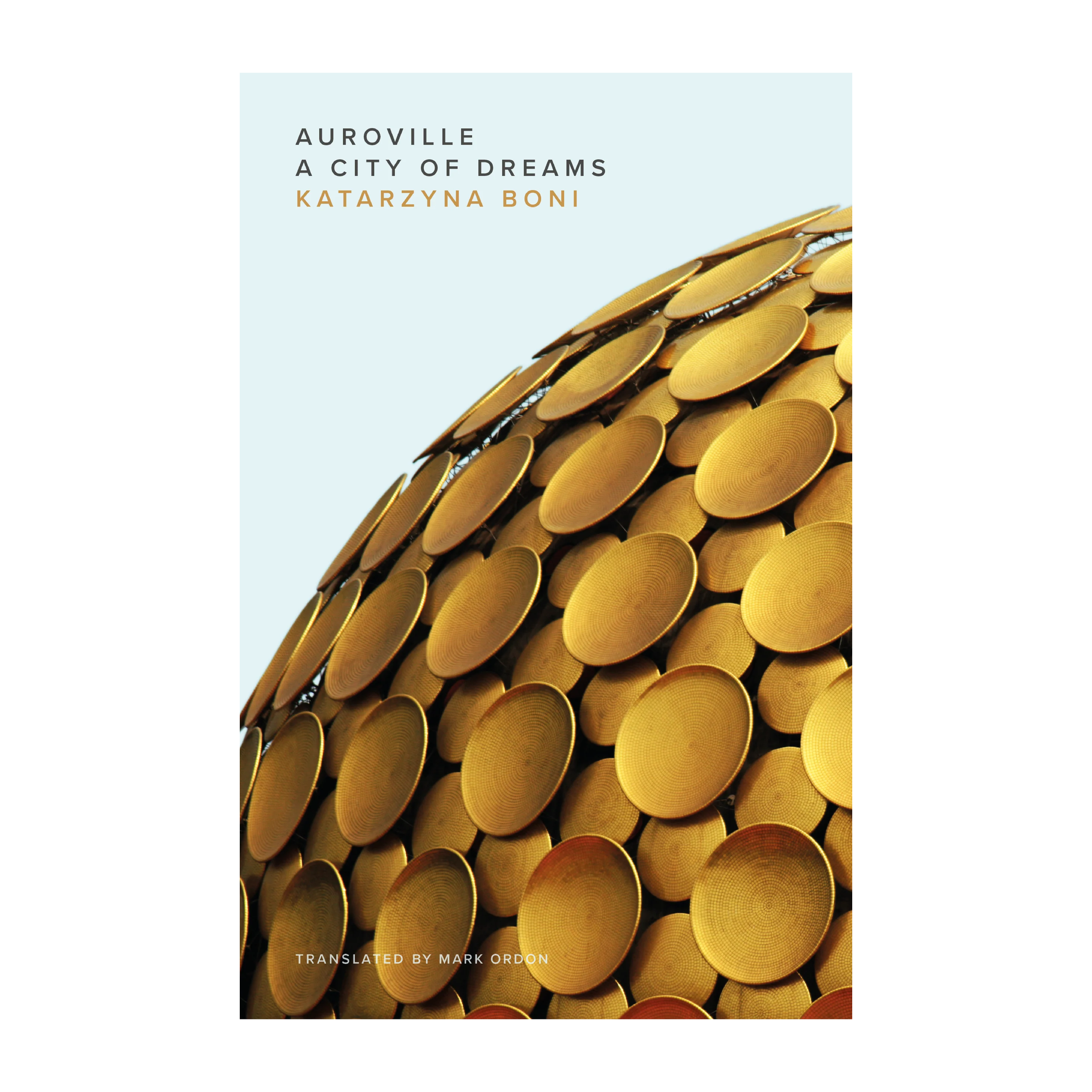
Katarzyna Boni, tr. Mark Ordon, Auroville: A City of Dreams. Open Letter Books, 2026. 512 Pages.
While contemporary postcolonial India is generally understood in relation to British colonialism, central also to the modern Indian nation state that comes out of anticolonial struggles in the twentieth century is French India, particularly the former French colony of Pondicherry, on the eastern coast of India, as historian Jessica Namakkal highlights in her book Unsettling Utopia: The Making and Unmaking of French India (2021). And, in turn, central to Pondicherry is Auroville, an independent city on its outskirts, located in the state of Tamil Nadu. Namakkal, early in her book, describes the city: “Designed to resemble a galaxy, Auroville was meant to be a launching pad for the postcolonial future, a break from the colonial past.” Auroville is a futuristic utopian city that was first designed to be the symbol of a new anticolonial worldmaking in the aftermath of empire. The originator of the space was the anticolonial and anti-imperial Bengali revolutionary Sri Aurobindo Ghose, who was born in Calcutta, and who due to his organizing against British colonial interests, sought refuge in French India——Pondicherry. In Pondicherry, he founded the Sri Aurobindo Ashram, which was a spiritual center that framed itself as “apolitical” despite Ghose’s anti-colonial roots and the ties French officials had to the space (Namakkal). The Aurobindo Ashram was the precursor to what would become the planned city of Auroville; while Sri Aurobindo had passed by the time the city was actually begun, his spiritual partner in the Ashram, Mirra Alfassa (who was French by birth and eventually relocated to India) developed and planned the city of Auroville. While the Ashram had inhabitants who were both European and Indian (though, as Namakkal notes in her book, from places other than Tamil Nadu), Auroville itself became largely a space for Europeans to settle——the first child born in Auroville, named Auroson, was the son of two Western settlers.
“I read in a guidebook that right near Pondicherry, a former French colony, there is a city in which people from all over the world are trying to build a society without money, private ownership, institutions, religion, or divisions. Everybody is invited,” writes Polish journalist Katarzyna Boni in the opening of Auroville: A City of Dreams, a hybrid work of memoir, journalism, and oral history. Translated into English by Mark Ordon, the book takes as its focus the planned utopian spiritual community of Auroville. An international, cross-border utopia that seemingly works against the currents of class and capital, Auroville is immediately situated, in Boni’s imagination, as a place with endless possibilities of radical optimism. The book is divided into three sections, each anchored by a specific avenue of inquiry. The first takes as its focus Auroville’s planned utopian beginnings, the second as its focus Boni’s own experience of the city as it existed during her visits, and the third the history of Mirra Alfassa, the woman who shaped the beginnings and futures of Auroville. Auroville: A City of Dreams seeks to examine how Auroville exists today in relation to its beginning, to think through the trajectories and visions that shape it in the present day, long after the passing of both the founders, Sri Aurobindo Ghose and Mirra Alfassa. Ultimately, though, it fails to engage meaningfully with how Auroville exists today in relation to the political currents it comes out of, and is only interested in Auroville as an idea and a spiritual landscape rather than as a material place that carries the contradiction of both colonial and anticolonial pasts, presents, and futures.
A controversial space within India itself, the intentionally cosmopolitan and international Auroville was preceded by the Sri Aurobindo Ashram, which was founded in 1926. The Ashram was the first site of Ghose’s partnership with Alfassa, who came to be known as The Mother. Alfassa was born in Paris, and met Sri Aurobindo in Pondicherry, and then, after a few years in Japan, returned once more to establish the Ashram. Both of their lives were deeply entangled in larger transnational struggles and political currents of the world at the time, and Auroville was intended to be an extension of their shared anticolonial and anti-imperial vision. While Sri Aurobindo Ghose was its namesake, the space was constructed and envisioned by Alfassa, and was inaugurated eighteen years after his death in 1968.
In Unsettling Utopia, Namakkal argues for an understanding of Auroville as a settler colonial project, and uses the phrase “spiritual settlement” to describe the practice of Westerners with particular spiritual ideas in relation to India choosing to move to Auroville. She contends that Auroville, while making anticolonial promises, instead enacts those very same colonial logics through its practices of displacing local populations, its desires and insistences on being outside of India despite being contained within it, and its removal from the local Tamil populations. Namakkal also recognizes, at the same time, that Alfassa was an anticolonial activist. The coexistence of these facts is what shapes Auroville today——that it comes out of anticolonial possibilities, and in the years since, has become something very colonial in its practices.
Much like Auroville itself, Boni’s book enacts the erasure of the India that shapes and surrounds Auroville. The opening of the first section of the book begins with a moment of global contextualization. Boni writes: “The year 1968 started on a Monday and was not gracious to the world.” Boni goes on to highlight central political moments globally——in Vietnam, in Memphis, in Chicago, in Detroit, Warsaw, China, Prague, Mexico, Hong Kong, and more. And yet what remains absent from this list is India itself, the India that ultimately contains Auroville, the India that Auroville situates itself in opposition to.
In addition, in describing Auroville in its early days via Renu, an Indian girl, Boni focuses on tired descriptions of poverty and animals that remain absent when she chooses the perspective of the white settlers who choose to inhabit the place. Boni writes:
As it rattled over the bumps, the cement mixer thundered like the world was about to end. A gray buffalo with crescent-shaped horns, a wet-muzzle, and fur blackened by sweat. The cart got stuck in the sand several times, and everyone tried to push it. When the cement mixer finally made it to the construction site, Renu clapped her hands and jumped for joy.
The tone of this section takes on a paternalistic quality towards both the landscape of developing India and to Renu herself——in attempting to situate Auroville in relation to the surroundings, the book ultimately enacts the same separation of past and future that the conception of Auroville did. Here, Auroville: A City of Dreams reinforces Orientalized tropes of India——an India that is “spiritual” and that is largely framed by poverty. “Auroville is in many ways a thriving project today that continues to shine a positive light on the colonial memory of French rule in India, a space that invokes a relationship with the colonial past while also emerging as a global site for spiritual tourism, green capitalism, and settler utopianism,” writes Namakkal. Boni’s book, instead of engaging meaningfully with Auroville as a site of these specific contradictions and power dynamics, remains rooted in myth-making, choosing to continue serving the problematic narrative logics of Auroville.
Moving between different moments in her life, Boni opens with a brief contextualization of her own personal history with the place and the hold it had over her life in the following years, as she returned to Auroville for short durations. In the first section of the book, “The Dream,” Boni situates the beginnings of Auroville in 1968——its origins, the people who came there first, their experiences of the city, and its growth, until the present day. By nature of what the book’s literary project is, the use of both archive and speculation create an evocative portrait of the lives of the people who make Auroville. Archival material and interviews provide a scaffolding, but the language itself is infused with a degree of emotional depth and narrativization that necessitates some speculation. It is impossible, in Boni’s understanding, to study Auroville merely as a historical experiment; just as important as Alfassa or Sri Aurobindo are the people who first bought into the promises of utopia in Auroville.
Very few of the residents of Auroville Boni chooses to focus on here are Indian, despite Indians accounting for a majority of the population of Auroville; instead, the book is largely about outsiders who, to use Namakkal’s phrasing, “spiritually settle” Auroville, intent on seeking some kind of spiritual enlightenment after finding themselves discontent with their lives in North America and Europe. Boni devotes a generous amount of time to Charlotte——later named Shyama by Alfassa——and Frederick, who would meet in Auroville and later become parents to Auroson. In the opening of the first section about Charlotte, Boni writes:
In 1965, Charlotte left her three children under the case of their father and their nannies. Her relationship with Rajat Neogy, a Ugandan poet of Indian descent, an alcoholic, and editor of Transition, the most influential literary magazine in all of Africa, had been deteriorating for many years. But Charlotte didn’t want to recognize that. Even if the same trivial question had been eating away at her more and more: what is the meaning of my life?
In a similar vein begin all of Boni’s sections that outline personal lives——opening with the world at large, and the closing in on the impulse to arrive in Auroville. In each of these instances though, the portrait Boni paints is similar: white tourists who desire some kind of spiritual awakening, who think they will find it in India. Ultimately, despite Boni’s creation of their individual circumstances, she does so uncritically, seemingly unaware of the neocolonialist tropes perpetuated by the constantly reiterated story of the Westerner seeking spiritual enlightenment in the East. In the above excerpt, the text’s lack of engagement with the neocolonial encounter remains exceptionally apparent: Charlotte is briefly situated in relation to her partner, who is contextualized in a way that hints to geographical transnationalism. But where there is an exciting potential for political transnationalism——the mention of Transition magazine, in addition to the political moment happening outside Auroville, the immediate aftermath of decolonization in the Global South, the possibilities and futurities contained therein——of which Auroville certainly in its early days was a part, Boni’s book remains with Charlotte only, centered in the Westerner’s spiritual encounter with Auroville. More than an interest in engaging with the politics of anticolonialism in the post-decolonization moment, Auroville: A City of Dreams is more interested in using lush language to create an ultimately false sense of emotional depth in the white tourist who comes to India, lured by the cosmopolitan utopianism of Auroville.
In the second section, “The City,” Boni, starting with a chapter titled “The Road,” puts the reader in her shoes, from her arrival in Auroville to her conversations with the cast of characters she meets in the city, all of whom bring different perspectives. Here, time is made malleable, condensed for clarity across Boni’s many trips over the years. With a journalistic bent, Boni narrates the journey of how she came to arrive at the answers the first section holds, including her attempts to speak with Auroson, the child of Charlotte and Frederick, the first child born in Auroville. Focusing on her attempts to interview inhabitants of Auroville and a more day-to-day experience of the place, this section is the most exciting of the three sections with a stylistic and formal urgency in this section. No longer bogged down by the necessity of creating an evocative history and compressed by Boni herself finally being present in the narrative, this section takes on understanding the emotional and social landscapes of contemporary Auroville. Now in Auroville, where last names are not permitted, Boni becomes Kasia, and Kasia must either commit to becoming an Aurovilian, or leave soon. This compression of time also helps lend the narrative a temporal urgency, which proves more useful in moving the book along than either of the previous sections that take on mythological qualities.
Boni’s tracking of Auroson is central to the way the book as a whole writes into and with myth-making. Auroson’s trajectory begins with Frederick and Charlotte in South India, but takes him across the world, as he leaves and returns, drawn away and back over the years. This tracking, while certainly journalistic, ultimately fails due to the way Boni structures her narrativization of Auroson. In the very beginning of the book, Boni includes a short prologue, opening with an encounter between Auroson and a wolf. “The white wolf was lurking in the shade, Auroson felt his presence,” writes Boni. Auroson continues to be “unable to see the animal” and Boni continues to say:
He could feel a chill on his neck, he was already inside. A tight passage, dark, and every tightening was suffocating, drawing one into one’s most personal fear.
It’s like I’m being born again. This is unbearable.
This scene of rebirth, with its dreamlike qualities of the tension between Auroson and the wolf out of sight and the spiritual changes it forces for Auroson, is another way through which Auroville: A City of Dreams is primarily interested in reinforcing the mythologies the place and community subscribe to rather than center the journalistic impulse to document Auroville as it actually is.
At this point in the narrative, utopia comes into focus; in this section, Auroville is no longer the Auroville that Mirra Alfassa sold to the world. It has become a cult-like version of itself where Alfassa and Sri Aurobindo are worshipped, their photos hanging everywhere despite their wishes to the contrary. Auroville, when Boni visits, is a place where Aurovilians have to pay monthly fees, have to prove financial viability when they apply to arrive. While tenets such as no private ownership have remained, Auroville, in this moment in time, has chosen larger forces of late capitalism that shape the currents of the world. Rather than remain in the anticolonial and anticapitalist promises Alfassa envisioned, Auroville has become a space of financial gatekeeping, alongside its cultish worshipping of Alfassa. At this moment too, the absence of the nation-state becomes especially apparent, as similar logics are enacted on a national stage, as right-wing authoritarianism and ethnonationalism increases, alongside rapid globalization. As Auroville has given way to a more colonial version of itself, India too is a radically different nation than envisioned in the moment immediately after decolonization, especially with the nation’s rising ethnonationalism and crackdowns on dissent.
The third and final section of the book is part origin story for how Mirra Alfassa becomes The Mother and part biography. She is cast into myth, with rich, vivid language that is less interested in the concrete materialities of this inherently colonial project and more interested in framing her as understood by the residents of Auroville. The section about Alfassa closes on a chapter titled “New World,” which frames, in retrospect, everything that the book thus far has built towards. In this section, Boni describes the vision Mirra Alfassa has for the utopian potentialities of Auroville on February 29, 1965. Boni writes: “Mirra laughed quietly at them: unaware as children. A month later she wrote that a new world was born that day.” While it might be possible to read Boni as a critic of the paternalism of Alfassa, and of Sri Aurobindo by extension, the arrival of this moment, at the end of the section devoted to cataloguing Alfassa’s life, turns this condemnation into a reinforcement, uncritically narrativizing the story of Auroville for the consumption of a Western audience.
Auroville, as initially envisioned, certainly was full of radical anticolonial promise, but following the passing of Alfassa, Auroville has become a utopia that money can buy. And to highlight this tension of Auroville becoming the very capitalist enterprise it once envisioned itself in opposition to without engaging with the ways globalization, late capitalism, and rising right-wing authoritarianism have become a part of the modern nation state of India is ultimately irresponsible, enacting a colonial narrativization of Auroville. Ultimately, the book is more interested in treating Auroville as an example of a utopia that might be realized, not as a real place occupying political memory in a material way. Boni’s book is hypnotic in its mythical approach, almost asking the reader to submit to this tonal quality rather than critically approach its subject. Both Aurovilles——the place and the book——ultimately are interested in only acknowledging the anticolonial premises of that resulted in the first imaginings of the place, but remain fundamentally uninterested in thinking through the contemporary transnational political frameworks and histories, those by which Auroville came to exist.
Works Cited
Namakkal, Jessica. Unsettling Utopia: The Making and Unmaking of French India. Columbia University Press, 2021.