
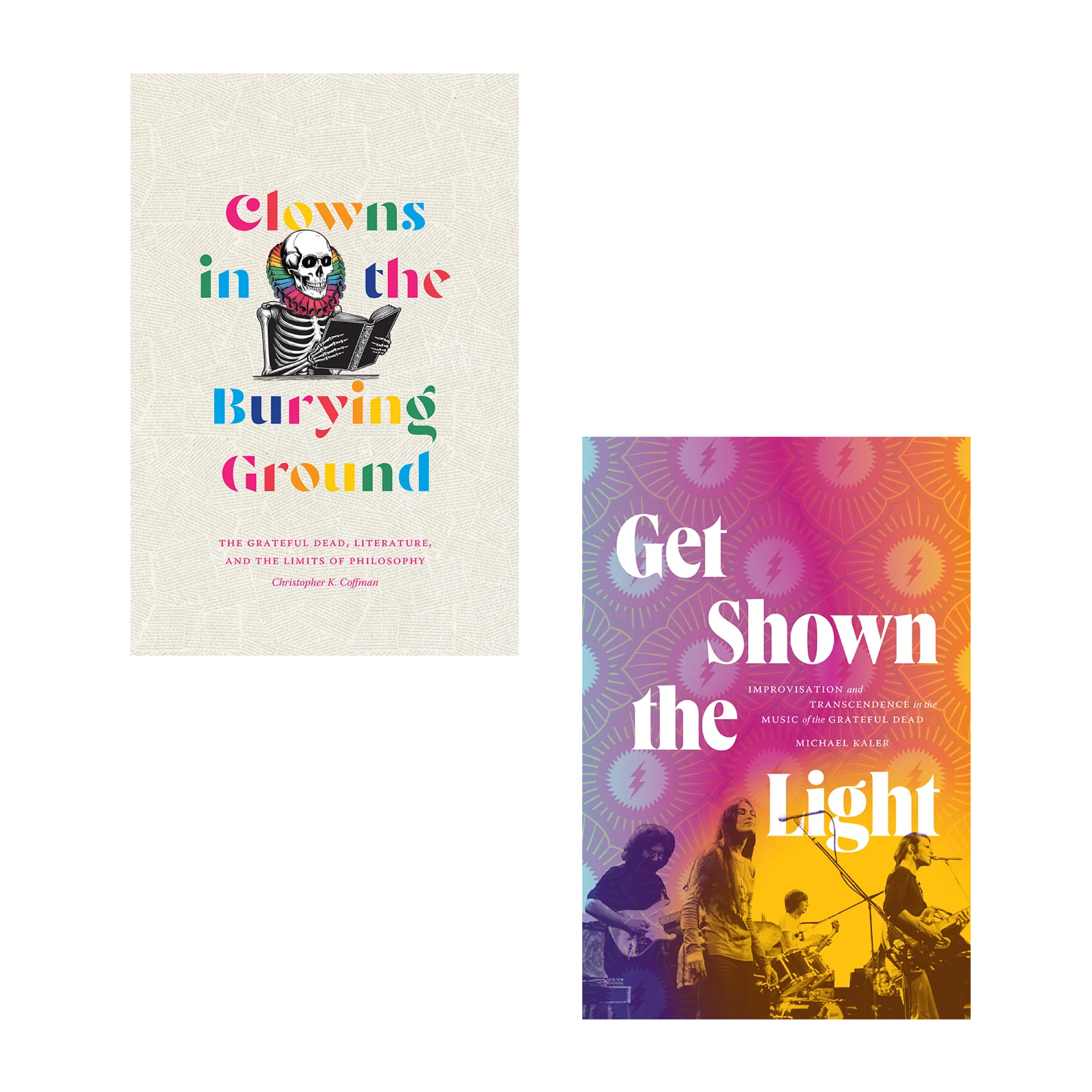
Christopher K. Coffman, Clowns in the Burying Ground: The Grateful Dead, Literature, and the Limits of Philosophy. Duke University Press, 2026. 262 Pages.
Michael Kaler, Get Shown the Light: Improvisation and Transcendence in the Music of the Grateful Dead. Duke University Press, 2023. 304 Pages.
“Out on the road today / I saw a deadhead sticker on a Cadillac,” sings Don Henley in the hit 1984 single “The Boys of Summer.” He later explained the line:
I was driving down the San Diego Freeway and got passed by a $21,000 Cadillac Seville, the status symbol of the right-wing upper-middle-class American bourgeoisie——all the guys with the blue blazers with the crests and the grey pants——and there was this Grateful Dead “Deadhead” bumper sticker on it!
Well, the other day I was driving down Soldier’s Field Road in Boston in heavy traffic. And I noticed the car in front of me: a Kia Niro with three stickers. One was for the USGS (U.S. Geological Survey), the next read “I’m a Geologist.” I was beginning to put together a mental picture. The third——very subtle, b&w, discreet——was a steelie, the Grateful Dead skull logo.
If the driver of Cadillac Seville was a middle-aged Republican asshole, then who’s driving the Kia Niro? Some sort of nerd scientist? What happened to the crunchy burnout deadheads of yore? Have we moved beyond simulation into simulacra?
Hardly. Let me introduce the egghead deadhead (EHDH). We look just like you. We work white collar jobs, updating cell blocks in spreadsheets, managing information. Some of us work in the academy. However, for most of us EHDHs, our EHDHism happens on the DL. Dead music’s in our earbuds as we draft our emails and it plays over our home speakers as we grade papers. We’ve been around almost since the Dead’s inception, and we will last as long as the music.
Some history: before the Dead were the Dead, they were The Warlocks. For copyright reasons they had to abandon that name. On the east coast, another band called The Warlocks were also asked to change their name. That band became The Velvet Underground. In the two former Warlocks you get a nearly complete picture of the white American counterculture that flowered in the 1960s. It was always actually two countercultures. Counterculture A was the cool one——cerebral, edgy, urbane, angry, and perverse. This is the VU strain. Counterculture A includes the Stooges, the New York Dolls, punk, no wave, Pere Ubu, hardcore, post-hardcore, and noise rock. Counterculture B, the Dead strain, was the softheaded, barefooted one——hippified, mystical, turned on, tuned in, and dropped out. Counterculture B includes psych rock, sunshine pop, country rock, David Crosby, prog, and jam bands.
Counterculture B was always a bit more assimilable to the mainstream. For every psychonaut who joined a commune up in Bolinas or Mendocino, ten eventually modified their drug intake, cut their hair, and got a job. The yippies became yuppies, and Jerry Rubin went from dressing up like a Viet Cong member to proselytizing the prosperity gospel. They sold out, man. Counterculture B is mellow, and one can be just as mellow in a suit as in tie-dye and Guatemalan drawstring pants. Deadheads lacked Counterculture A’s righteous anger, and it turns out you can experience peace and love in a cubicle.
Not all of us were so mercenary. The EHDHs have noble members in our ranks: Bill Walton, autism historian Steve Silberman, trans activist and writer Jennifer Finney Boylan, and Ben Cohen of Ben & Jerry’s. But Tucker Carlson and Ann Coulter also number among us, eldritch figures whose evil transcends mere yuppie opportunism.
That’s the Egghead Deadhead, a heterogeneous bunch. For most of our existence we moved in silence, frequently asked, in astonishment, “wait, you’re a Deadhead?” But the quiet fandom could only last so long. One of the laws of the academic humanities: get enough people together in a room with a common niche interest and within a couple of minutes a new “studies” will be born. Thus, Grateful Dead studies.
Or rather, following Duke University Press, Studies in the Grateful Dead. A new series of monographs, beginning in November 2023 with Michael Kaler’s Get Shown the Light, followed a month later by John Brackett’s Live Dead. There was a couple-year gap, but this year the series has recommenced in earnest with an additional two volumes: Christopher K. Coffman’s Clowns in the Burying Ground and Brackett’s second monograph, Touch of Grey, or How the Grateful Dead Became Pop Stars (so far unread by this critic).
Some people, when they’re excited about some or other bit of culture, try to seek out some sort of fan community, increasingly online. Others, eggheads, might look it up in JSTOR. For the latter group, a new series of academic texts on the Grateful Dead is a real boon. While there is no shortage of amateur Dead scholarship——archives, analysis, histories, biographies——the Egghead Deadhead’s intellectual appetite is voracious, and the rigors of the academy offer the possibility of new insights, new trivia, new context, and a richer, deeper Grateful Dead listening experience.
I recently had plans to meet up with some folks in New York City to see a Dead tribute band. I had been looking forward to this show for months. Unfortunately, the New York governor issued a state of emergency due to a storm, and the venue cancelled the show soon after I arrived. We decided to meet up at a bar instead.
The group was a mix of journalists, academics, lawyers, etc. EHDHs. One of the things I was excited about was that I expected, by writing this review and reading these academic monographs on the Grateful Dead, to arrive with interesting Dead knowledge and theories, perfectly catered to the Egghead Deadhead crowd. And yet, as I walked from my sister’s apartment to the bar, I felt like the information I’d gathered from the books would in fact not be that interesting to my prospective audience. Would people care, for instance, that Jean-Luc Nancy’s theoretical work on the fragment kinda-sorta resembles Robert Hunter’s lyrical method in some songs, or that John Perry Barlow’s approach to bucolic lyrics differs from Hesiod’s?
In fairness to the books, the cancellation had put me in a sour mood, the bar was quite loud, and I’d had a couple of beers; none of these ideal preconditions for the agile recollection and display of trivia. In the sober light of day, after my disappointment faded, I was able to reflect on some interesting things I’d learned.
John Brackett’s Live Dead, for example, offers sociological insight into the band’s particularly strong connections with its fans. For him, it has to do with the band’s live show. He advances a convincing theory on why “liveness” is such a treasured quality for The Dead and its fans, and why it has been so since the beginning. He quotes an enthusiastic 1967 Village Voice article on the Haight-Ashbury scene: “the important thing about San Francisco rock ‘n’ roll is that the bands here all sing and play live, and not for recordings.”
Brackett argues that The Dead’s “liveness” serves an ideological function, as a confirmation of the mutually reinforcing importance of both musician and audience. He quotes Jerry Garcia on the band’s social function, “we like to play for dancers.” and later quotes Garcia arguing, “I don’t believe the live sound, the live excitement can be recorded.” Garcia was emphatic on the importance of the interaction between band and audience. The audience is central to the improvisatory ethos of the band. Improvisation allows the band to maintain a newness, an “excitement” for and responsive to the audience of Deadheads. The band and its audience performed in concert with each other.
For EHDHs interested in the music itself, Michael Kaler’s Get Shown the Light dives deeper into the specifics of the Dead’s improvisations. I’d long known about Bob Weir and Phil Lesh’s love for the mid-60s Coltrane Quartet, though I’d been suspicious that the claims of influence were exaggerated. It doesn’t matter how many times Weir said it, his oddball trebly rhythm guitar never really sounded like McCoy Tyner’s blocky percussive piano. So, it’s useful to read Kaler’s careful explanation of Lesh’s incorporation of modal harmony, as well as the less often stated importance of R&B improvisers like Junior Walker & the All Stars. Kaler usefully periodizes the Dead’s approaches to improvisation, allowing listeners to better hear how the band developed over time, why a jam section from 1973 sounds so different from one in 1969.
Kaler’s also astute on the band’s compositions, coining descriptions for certain tunes that capture and clarify what makes them distinctive. I particularly admired the way his description of “trap door” songs——he lists “Alligator,” “Cardboard Cowboy,” and “Dark Star”——captures the way these songs cultivate mystery: “The impression created by the trap door songs is not so much that of a journey, as in the movement through sections approach, but, rather, one of the juxtaposition of two worlds: an esoteric and usually longer, stranger, and more disconcerting one nestled within an exoteric one.”
I was most excited to read Christopher Coffman’s Clowns in the Burying Ground, a deep dive into The Dead’s lyrics and their connection to philosophy. If I were doing missionary work on behalf of us Deadheads, the aspect of The Dead that I would most emphasize, the quality with the greatest universal appeal, would be the lyrics of Robert Hunter.
In certain circles this is heresy. For many, the true hero of the Dead, the heart, is the ragged and cuddly lead guitarist Jerry Garcia. Talk to enough Deadheads, or turn the SiriusXM radio dial to channel 23, and you’ll hear that Jerry Garcia is the best country guitar player since Don Rich, the best bluegrass guitarist since Doc Watson, the most skilled rock guitar player behind Jimi Hendrix, and the greatest improviser——bar none——since John Coltrane. I love Jerry, but none of this is true. Jerry Garcia is the best Jerry Garcia-style guitarist, the amalgam of his taste in jazz, country, bluegrass, rock and folk, at the behest of his chops (the level of which varies over the course of his career), with his melodic sensibilities. He’s utterly singular, and for those in tune with his style he can be engaging for remarkably long stretches of time, but he’s an acquired taste.
The only Dead member who has any shot at being considered best in their individual class is in-house lyricist Robert Hunter. He wouldn’t be my pick——Bob Dylan’s messy virtuosic expansiveness, Joni Mitchell’s richly textured narratives, and David Bowie’s jagged, fractured symbolist monologues hold pride of place——but there’s a case for Hunter.
Here’s the case:
1. His ability to occasionally write songs that so successfully channel American folk music that they feel like they’ve been around forever. See: “Friend of the Devil,” “Cumberland Blues,” “Black Peter.”
2. A koan-like mysteriousness, phrases that seem infinitely vast. “Ripple” is full of these lines. See:
Reach out your hand, if your cup be empty
If your cup is full, may it be again
Let it be known, there is a fountain
That was not made by the hands of men
3. His ability to synthesize late-19th century romantic poetry at its most ornate and visionary with rock lyrics. See: “Franklin’s Tower,” “Eyes of the World,” “China Doll.”
Coffman brings an immense amount of learning to bear on this most literary of songwriters. He has a knack for uncovering allusions that, in retrospect, are head-slappingly obvious——which is no easy thing. For years I’ve been baffled by the enigmatic “Mountains of the Moon.” Coffman’s careful reading of the lyric shows that the song is threaded with characters, scenes, speeches, and songs from King Lear. The reading of “Dire Wolf” in particular is virtuosic, situating a song which can seem like a merely morbid joke in a long Scottish folk tradition and highlighting the lyric’s gothic content.
He takes his critical task from the epic “Terrapin Station”: “his job is to shed light / and not to master.” I think that he succeeds. His context and scholarship deepen rather than dispel the strange mysteries of Hunter’s lyrics. Coffman never gives the sense that he thinks his reading is the only correct one. The effect is rather that of a generous and learned conversational partner, offering hypotheses and making unusual connections.
Sometimes, however, the excitement and potentially broad interest of Coffman’s interpretations is hampered by his style. Coffman’s prose bears its origins in the academic humanities, for good and for ill. Often, he indulges in the passive voice endemic to academic writing. For example, early in the book, he writes, “Few thinkers have done as much as Jean-Luc Nancy to articulate the import of the fragment for modern philosophy, and for this reason, some familiarity with his thought on this front is helpful.” Sentences like this abound in the book, especially in the sections on philosophy. I began to think of the philosophy sections like many Dead listeners think of “Drums/Space,” as time for a break.
Another frustrating tendency is Coffman’s need to define every term, regardless of whether the term is at all useful. For example, we don’t need an extended history of the georgic, from Virgil to Gary Snyder——before diving into the Weir/Barlow song “Let it Grow.”
The formality of the prose in many of these books renders some of their descriptions a little limp. Historically, the Dead have spurred very vivid writing, like Tom Wolfe’s account of a Dead show in The Electric Kool-Aid Acid Test:
The Dead’s weird sound! agony-in-ecstasis! submarine somehow, turbid half the time, tremendously loud but like sitting under a waterfall, at the same time full of sort of ghoul-show vibrato sounds as if each string on their electric guitars is half a block long and twanging in a room full of natural gas, not to mention their great Hammond electric organ, which sounds like a movie house Wurlitzer, a diathermy machine, a Citizens’ Band radio and an Auto-Grind garbage truck at 4 A.M., all coming over the same frequency.
Only Kaler attempts similar lyricism, albeit in a more plainspoken register, like when he aptly describes Jerry Garcia’s “ragged-but-right, laid back approach.” Coffman and Brackett’s more dispassionate style, while informative, fails to capture the experience of listening to The Grateful Dead in the same way. It was this lack that informed my grouchy refusal to mention the books during my trip to New York.
Nevertheless, I have come away from reading this series a much more informed Deadhead, more Egghead than ever. EHDHs should be grateful to Duke University Press for funding such a project, and to series editor Nicholas G. Meriwether for putting it together. I never expected that I would learn so much Deadiana from JSTOR, but as the poet says, “Once in a while you get shown the light, in the strangest of places if you look at it right.”